

I urge everyone to watch this review of this movie (spoilers) and/or just watch the movie.
The Relevance of the 1993 Movie 'Falling Down' to Contemporary Society: A Critical Analysis
1. Introduction
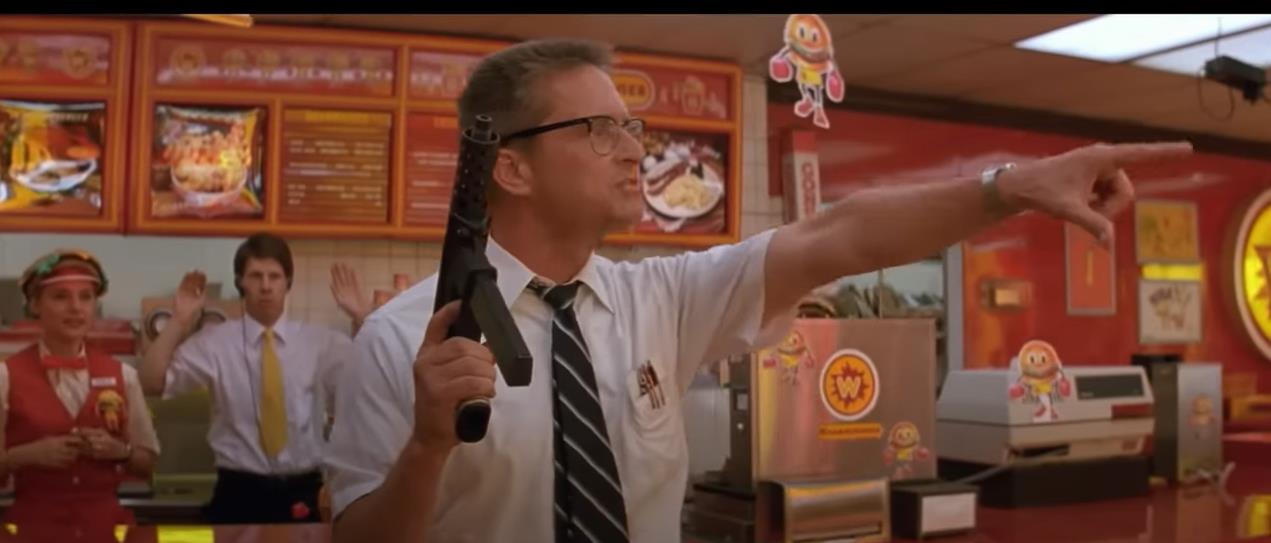
The work is divided into five main parts. The first is this introduction. In this introduction, I provide my viewpoint on the issue: the relevance of the movie to contemporary society and what contribution it makes to understanding the role, issues, and influence which the mass media in general and the night news in particular have on society, and the movie project and the intentions of the producers of the movie. The second part of the paper identifies and profiles the 1993 movie. It describes the essential features of the movie and the sort of people who would be expected to see the movie and keep on talking about the issues raised by the movie. The fourth part of the paper provides an account of my analysis, which is based on critical assessment of the text as well as parallelism with existing theoretical and empirical scholarship on the contemporary mass media and society. The fifth part of the paper gives my closing comments and suggests some recommendations.
I am here this afternoon to present a paper that is based on my current research on the relevance of the 1993 movie "Falling Down" to contemporary society. This came about by very close reading of the text of the movie in a Mass Media class I took as part of the university's undergraduate academic program. The paper does not have very much theory, as is the norm with contemporary film, but it draws out important critical issues that the movie brings out with regard to contemporary mass media and society at large. The critical points are drawn out by close examination of the text and through parallel with existing empirical and critical scholarship carried out by eminent scholars in the field of the mass media and society at large. So this is not to be a reference to important academic scholarship in this advanced contemporary critical field, but it is intended for class discussion, representing the views of a contemporary citizen about how the mass media, in particular the night news, influences the anticipation of the issues it will see in society.
1.1. Overview of the Movie 'Falling Down'
During the course of Bill's walking journey through LA, the viewer is dished with a small clue about his current mental state when he walks into a local store and buys breakfast. The store is owned and operated by an oriental proprietor who offered the storekeeper's limited command of English while Bill is strikingly polite. However, the movie makes you feel a trifle disheartened when Bill loses his first battle with the contemporary society. The storekeeper refuses to accept Bill's valid change of the thirty cents in what is undoubtedly an illustrative contemporary money-minded society. His next retrogressive act strikes the audience suddenly. Bill pulls out a .38 special from his briefcase which he purchased from a gangster defense worker turned revolutionary, although he did not intend to use it in a violent manner.
The plot of the movie "Falling Down" revolves around the events surrounding an unemployed and downtrodden defense worker, William (Bill) Foster, appealingly portrayed by Michael Douglas. On one hot and jam-packed Los Angeles morning, he directly walks away from his vehicle stuck in a rush-hour traffic jam. It is significant to observe that it is this hot weather and the unceasing mind-boggling traffic jam, ostensibly occasioned by road works, that act as the initial pricking factor which contributes to Bill's total disenchantment with life. He had had enough and decides to leave it all behind to embark on a walking journey to his little daughter's birthday party. The greater proportion of the movie focuses on these events that were initiated by the traffic congestion that had reached boiling point.
1.1 Overview of the movie Falling Down
2. Social Context of 1993
It was a world where existence was more important than essence, where moral and social norms of a previous age crumbled under the pressure of the hardships of a post-industrial age. The industries that were the economic spine of America vanished very quickly. In their place, advanced knowledge corporations and the lower-paid service industries that catered to the needs of the advanced knowledge corporations themselves fueled the growth of the horrendous accumulation of capital by some of its elite. Corporate America stood clear and smiling in full view of the political leaders of the time. It was a time where the old family-owned businesses were bought out by larger organizations. The little words carefully carved in wood, "Smith's Fresh Pies," were snapped up and stashed away as a source of competitive location. Small businesses not swallowed up by the ecological darkness that is the advanced knowledge corporation still survived. They had to constantly struggle in real wars against entrenched bureaucratic mindlessness whose thirst for profit was in stark contradiction to the societies' normative ethical preoccupations.
Following the era of the 1990s, a death-knell rang on the Cold War as the incumbent divisions between the world's communist and capitalist nations fell to a crumbling. The most significant impact of that order was not a war, but a chilling effect on the imagination and creativity of a generation - the 'Baby-boomers'. They had lived through a period of history that would most accurately be described as periods of hope alternating with those of despair, occasioned by conflicts within and between societies themselves. At every twist and turn of their existence, they had lived a life of constant fear of an impending doom - a colorless, featureless world constantly on the brink of oblivion. It was not surprising, therefore, that a future in an uncertain world that they could bequeath to their children was the most urgent demand of their time.
2.1. Economic Recession and Social Discontent
The recession years and their aftermath have, therefore, made it evident that stability and control of instability were the most that residents of communities can really hope for. Many people in such communities have begun to realize that a level of employment income that is adequate for survival on its own is not a bad guide for those who are dissatisfied with and have no stake in prevailing institutions. Surplus labor has been matched by the overwhelming dissatisfaction with existing conditions among those suffering the greatest economic and human toll because of a weak labor market. Good Jobs First has shown that up to fifty percent of production workers lost their jobs due to plant closings and mass layoffs when the recession was at its worst. Such events, combined with existing labor and market conditions and income distribution changes, have raised the visibility and presence of advocates for these victims of racial and gender inequality. Instead, a reaction against those in economic peril has taken shape in the form of a stubborn refusal to ease the severity of conditions that produce the most social discontent among the audience's dissidents.
Falling Down is a 1993 movie that captures the anger and disillusionment that were prevalent in the early 1990s. The character of William Foster (played by Michael Douglas) can be viewed as a metaphor for the economic hardships that were endured during that time by many displaced or deindustrialized workers. He and many others like him find themselves currently or in the immediate future unemployed, unable to find work that is an adequate substitute for the jobs they lost. Their lives have been overturned and their worlds are collapsing, but because their problems seem to be caused by forces that they cannot fight, the enemies and antagonists of their discontentment are random and almost uniformly unrelated to anything that has directly threatened them. Their economic fears and anxieties translate into antagonisms toward and against the most banal and mediocre aspects of contemporary society.
3. Themes and Messages of the Movie
Society is portrayed in Falling Down as violent and problematic. D-Fens sees injustice everywhere, in the maltreatment of his former wife, the betrayal of his former employer, the sight of a policeman attempting to plant evidence for a murder. None of these people lives up to the beliefs that they are promoting. It is hardly surprising that on this one day of his life, D-Fens seeks to challenge the commonly held beliefs and practices that justice is served. These wrongs need to be righted, as do the actions of the shop owners who are overcharging or exploiting customers who see goods and profit as more important than low prices and meeting the needs of society, for example, cold drinks or a good meal. Yes, D-Fens is rather extreme in his actions. In Falling Down, violence is presented as both a solution and a problem. It is a refusal to face up to consciousness and reality. Critics of the movie Falling Down claim that the movie validates actions of violence. However, it could be said that society is just as violent as D-Fens.
The movie Falling Down includes many themes and messages. It explores themes such as family, society, law, order, and justice. The movie asks several difficult questions about contemporary society. Why are people becoming unhappy with life and how are they reacting? How are we living with severe economic pressures? It is quite clear from the start of Falling Down that D-Fens not only has problems with his personal life, but also with contemporary society. His planned route through Los Angeles is from the financial district to his former family. D-Fens crosses Los Angeles from uptown to downtown and on his "crusade" he sees people who are homeless, jobless, living in slums, or part of an ethnic minority. He comes into contact with several people forced to survive on the margins of society and the law. Just as society is increasingly excluding and rejecting D-Fens, D-Fens seeks to exclude and reject society.
3.1. Exploration of Anger and Frustration
Given that Falling Down was released in 1993, twenty-four years ago, it is fair to consider whether the movie still offers relevance to contemporary urban society. The recurrence of the protagonist but in varying social contexts within cities could indicate such relevance. Over twenty-four years or over several decades, the themes that are portrayed in the movie have overwhelming solidarity. This solidarity is achieved both in the context of the movie's characters and their sense of being left behind by the fast pace advances of society, and the associated practices within the movie industry, with Falling Down being only one of many movies that portrayed deeply troubled male individuals in contestation with their existence.
Falling Down exposes a number of themes such as anger and frustration that are present within a number of characters. The protagonist, D-FENS, is frustrated with the system he has to live with, as he struggles to cope with the maltreatment he experiences. This results in a character who is highly dissatisfied with his environment. This seems to be at the heart of the movie as it is in organizing his concerns and life that seem to underpin the central theme. It is also the key to the protagonist's downfall. While the movie could portray D-FENS as a dangerous ticking time bomb, he is always presented in a very human role, apparently reacting to maltreatment by others at the workplace and, by doing so, have little choice but to resort to behavior beyond the clearly acceptable. This engenders in the movie the audience's understanding, and to a point, sympathy for the character, while perhaps not his behavior.
4. Comparison to Contemporary Society
In a more general perspective, it affects all other sectors and threatens the very essence of civil society/post-civilization. The kind of "future" that works for all the socially organized, and is now increasingly based on an overwhelming use of missile-based military power over the environment, and to the neglect of the poor majority, refers to the legacy of summit opulence and wisdom. Its appeal to use the word "development" reinforces this conclusion, since it suggests significant progress that this concept best reflects.
In analyzing US society, it is necessary to establish a reference in order to analyze if it has improved, strengthened, or deteriorated. To do this, it would be useful to pay attention to several relevant facts regarding current social problems of the organization at this time, concerning violence, whether directly or symbolically. This society's present tragic situation is no less than the outcome of the future it seeks to collectively confront and resolve. The social disorder that pervades crucial sectors of US society, such as poverty, unemployment, pollution, public health, discrimination, domestic violence or intimate partner violence stigma, political inefficiency, racial tension, policy brutality, Maradays, the rising cost of living, criminal activity, and education against discrimination of different sexual orientations, has its specific space in bigotry.
4.1. Social Inequality and Polarization
This movie is basically about a man who claims his rights in a country that sells itself as "The land of the free". In this respect, it can be an extreme exemplification of the previous rights that the populist discourse offers as an exception to the most vulnerable sections, including the workers at the Ford factory where Foster works as an engineer at the beginning of the movie. Heavily psychological and generational research uncovers a bubble of intolerance that threatens to drag everyone else into its chaos. This bubble is directly generated by a model that inevitably drags downward a layering that might otherwise serve as a damper. In the movie, Foster, a white man, is able to access a house in one of the most peripheral and crime-ridden neighborhoods of Los Angeles.
Falling Down, a 1993 movie directed by Joel Schumacher, is thought to be a faithful reflection of American society fifteen years ago. The main character is William Foster, an unemployed divorcé who is increasingly unable to tolerate the heat, the traffic jams, and the indifferent attitude of his compatriots. The unavoidable end of his frustration finds a rich and intolerable man who honks his sports car at him stop suddenly. The frustrated character, though initially only wanting to find out why the other man was honking, kills him by accident. This is the first of the seven people he will kill en route to his ex-wife's house so as to attend the daughter's birthday.
This is just a scan and the following full will be on social inequality and polarization which I'm currently working on.
5. Conclusion
The emphasis of this study was on the critical analysis of the story and themes of the film "Falling Down." A content analysis method was employed to explore the relevance of the 1993 movie "Falling Down" to contemporary society, which depicts the story of a man, William Foster, who is frustrated with his life and therefore the society in which he lives. Foster is not able to cope with the demands of a changing society and eventually initiates a "war" against society, in which he fails. The study found that "Falling Down" is very relevant to the demands of contemporary society and that those who are unable to cope with these demands are, as in the movie, doomed to fail. The independent variables that were found to be critical in promoting the frustration of society members were the family and education, while additional factors included the effect of the global village, the economic environment of the times, and changes in society as a result of the rapid technological advancements in communication and control systems, which together provide higher standards of living, more freedom for some, and reduced job security and satisfaction for others. The trading-off of these benefits can contribute to frustrations created by the increasing gap between the rich and poor. This research can help to increase knowledge that would contribute towards a better understanding of the frustration and pressure aspects of members of society, which would be of potential benefit to researchers in the fields of psychology, sociology, and information systems alike. The goal of this research was to identify areas in which individual research could be conducted in order to provide a clearer understanding of this societal phenomenon.
5.1. Reflection on the Timeless Themes of 'Falling Down'
The movie also addresses the decency and integrity and essences of people and societal or technological forces that reduce people to grave or inadequate forms and from idealized archetypes of heroism. These themes do not date. People still live unreal lives, jobs are ever-changing, and notions of honor are ever challenged. Reflexivity plays a role here. It is easier to create power shifts and "power-with" than introduce egalitarian forms of power or escape power structures altogether. Santa seems almost engaging if encountered now in 2002. Gun ownership, social change, high performance, and SOCOY overprotection are all topics of great interest in the community. Finally and saliently, the deconstructionist themes around construct and controlling gaze are so heavily addressed in 'Falling Down' that they leave one breathless. These are themes that are central to contemporary media studies and public relations. The construct notion is central to creative Christianity and important to organizational charity. Control and the Construct and Social construction are essential notional material in contemplative communication with the Australian bush and should be at the heart of any communicative peace paradigm or peace haggard paradigm that focuses Release is Buddhism in action.
In spite of its limitations, the 1993 movie 'Falling Down' retains its power and relevance in part by examining universal themes. Although normative at the time, notions of entitlement, so harshly interrogated in 'Falling Down', continue to have contemporary salience in issues such as glass floor and glass ceiling effects in the workplace. In recent times, the entitlement of corporate managers has been hotly debated, with Richmond (2000) cutting through the "corporate baloney" to suggest simple statements which recognize the entitlements of corporate managers and return them to popularity. More generally, Rosman (2000) suggests that recognition of the "structure of feeling (or prickly popular resentment) into which the culture of making a business of business" would broaden cultural studies at this time (171). The glass floor sits with the glass ceiling; "a retrospective envy watched [the Boss of Stonemasons] return home to his splendid house... It was envy of his... congressman" symbolizes a broader social bitterness prior to the benefits of the late 1960s civil rights movement.