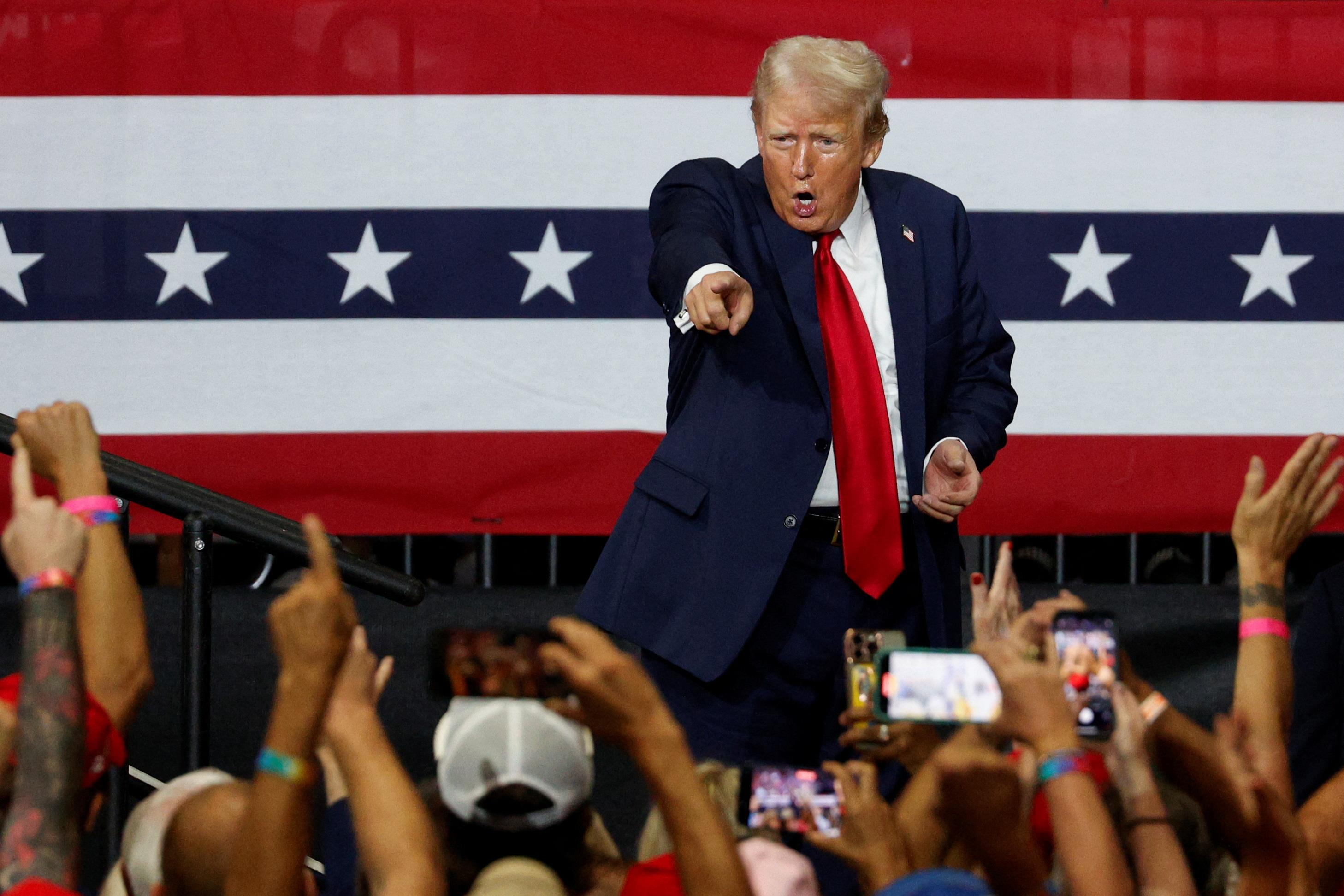
Analyzing Trump's Attempt to Appeal to Black Voters and His Claims of Saving 'Black Jobs'
So this article shows the intro. I did not show Trump's response, a “non-answer” and follow up attack on the journalist. MAGA's will claim the journalist attacked him - boo hoo don't cry - but journalists ask President's tough questions all the time and I did not see this as an attack. I think she could have been a bit more careful in setting him off but she went straight into “Let's address the elephant in the room”. A bit agressive of the bat, I will admit, but we're dealing with a President who's whole approach is aggressive, especially of the other side. He is nothing special in regards to this this treatment, but his character is revealing in that he treats aggression with further aggression to the point of using his political, wealth, and shady side-kicks to destroy those he does not like. Do you want this in a President? I want a strong leader, but I also want one that acts professional, can handle adversaries and dignitaries with grace, and is willing to work with the other side, both in Washington and in the country.
I have the same question as every other black person about his claim about illegals taking “black jobs”. Really??? What in hell is a “black” job? Oh my, I could write a novel on that. For someone to be racist is one thing, to be racist, claim strongly that they are not, then say that.. WOW!
This man fails on every professional level as a leader. My opinion of course, make up your own.
– Laveda Jones
1. Introduction
Analyzing in depth when Trump would attempt to appeal to black voters and how he rhetorically, contrary to some rhetorical norms, makes explicit identity norms that politicians typically keep ambiguous is crucial in this section. It is also essential to examine Trump's explicit claims about how he saved "black jobs" and thus averted the crime that he maintains white Republicans fear difference because criminals then exist in whatever the place is that they personally fear. The political motivations of the above two distinctions and the political upshot of saying crime as fear versus just saying crime as "like fear," which motivates real estate value and real estate action towards development, are also of great importance.
This paper has three focal points. Firstly, Trump’s explicit appeals to black voters and the way he puts the identity of these voters literally on stage will be examined from the perspective of one peculiar form of Trump’s norm-violation. It will be argued that there is a good deal of intentionality in Trump’s deployment of this “being racial”: it is constructed within a strategic, indeed deeply damaging, political dialectic in which, in the name of “fear” being aimed at behind one rhetorical strategy, another type of fear is incentivized and reproduced. Secondly, thus situating resistance to “identity politics” as “like fear” in relation to the social allowance for some as having some forms of legitimate claims, the notion of “like fear” instead of “fear” will be put into play as a form of logic responded to relevantized participants in the housing market.
1.1. Background on Trump's Relationship with the African American Community
A substantially fundamental aspect of the President's relation with Black voters and workers is often ignored. There are issues in considering his actions in the realm of civil rights and acknowledging either side of dramatic changes in access to the political capital of African American minorities. It is almost surely significant that counter protests against Black Lives Matter calls were centered on the names of Confederate generals. A feeling of supremacy is claimed. While the relative position of African Americans has varied in the 20th and 21st centuries, what is clear is that their access to the political capital of the United States has significantly expanded. Interpreting these details helps us better understand how an underwhelming and out-of-date argument could be somewhat persuasive in various ways.
The President used the occasion of his State of the Union remarks to claim that he saved "Black jobs" against such an unwarranted but historical backdrop. Higher overall changes in the national occupational structure, petulant Black members of the unemployed came down from a post-Depression peak of 21.2% in 2011 to 6.7% in 2019. Unemployment among black youth shrank from 39.63% in 2010 to 18.5% in 2019. These figures suggest that President Obama, not President Trump, is the beneficiary of whatever stabilizing effect the economic system may see in minority sectors in times of prosperity. Still, the President's record is more startling at the lower levels, with the federal minimum wage of $7.25 per hour today being worth less than it was in 1968 when it was favored and adjusted for inflation. In response, the Office of Budget and Management predicts Trump will produce substantial gains in jobs. A study by the American Association of School Administrators publishes every state a list of districts where an individual Trump administration official does not make an offer to hire African American candidates produces no effect but keeps all offers constant.
2. Trump's Rhetoric and Promises to Black Voters
Trump made a number of rhetorical appeals and promises to Black voters, but hyperbolically emphasized two: "I've done more for the Black community than any President since Abraham Lincoln," and "What the hell do you have to lose?" If Trump has done the most for African Americans since Abraham Lincoln, it suggests that he has surpassed every other president in terms of policies aimed at remedying—and apologies for historical injustices towards—those Americans whose ancestors were enslaved. For Trump, going to the people and asking for their vote is a sign that he was the best for them, and trust, the answer to the question is "nothing" as, aside from the lowest African American unemployment and poverty rates, "he has fought against the corruption of the political establishment and the special interests for the forgotten men and women."
It is possible that the "Nothing!" response was used not only to show that it was worth voting for Trump, but also to bring about certain discussions on norms that are not visible from the superficial reading of the answer to the question. There were other promises: "I am fighting for you, and I will always have your back." As president, Trump said that he "realized that our economic policies were actually arguably better for African Americans." This is what Trump said after he mentioned that since the COVID-19 pandemic, his administration provided "$2 billion a piece to Thomaston and Flextronics to rescue and shelter 3M jobs in a single working-class town outside of Austin, Texas." It is worth noting that it is not explicitly mentioned in the site why "Jackson" is jazzed if only townspeople will be able to get those jobs. In the factory that Trump referred to in his tweets, the workforce is "especially African American-dominated."
2.1. Key Statements and Appeals
Trump's speech was also notable for its detailed appeals to black voters. At the rally, Trump claimed to have done more for black Americans than any president since Abraham Lincoln – an argument he made to a predominantly white audience at his first re-election rally in Tulsa in June last year. "I'm fighting for you, I'm not just fighting against the radical left, Marxists, socialists. I'm fighting against a lot of incompetent, very stupid people. I'm fighting a lot, because I don't want to steer. I'm fighting for you," he said. "You know, and I say it and I'd say it, I said it (in Tulsa) – I've done more for the African American community, can you believe, than any president, other than maybe Abraham Lincoln, an argument I've settled. A lot of people agree, many people agree; many presidents were very good."
Democrats dominate the black vote in the US at a level unrivaled in any other age or demographic bracket. In the 2020 presidential election, an exit poll by Edison Research suggested President Trump received just 12% of the black male vote, an increase on his support from the demographic in the 2016 election. More black women than black men voted for the Republican incumbent, according to the poll. In September, President Trump appeared in Atlanta, Georgia, to formally launch his black economic empowerment "platinum plan", with specific detail dedicated to job creation and on the stance that "opportunity knows no bounds." His administration claims his policies have driven two years of record low unemployment for black workers prior to the economic downturn directly caused by the coronavirus pandemic. A mix of health fears and mail-in voting initiatives appears to be driving early voting turnouts toward record levels, amid predictions of 150 million Americans voting in total. Early voting does not necessarily indicate any demographic voting shift.
3. Analysis of Trump's Policies and Actions
Debates about the relevance of political actions, as well as the consequences of different policies (e.g., to reduce or expand the welfare state), are common not only from a citizen's perspective but also from policymakers and think-tank organizations. Since Trump rose to power, these discussions have gained more ground. Republicans claim not only that he did not make Americans worse off but better off—irrespective of race, gender, and so on. Beyond the costs of Trump's withdrawal from the White House, with or without Republicans' idealization of him, however, a narrow focus is missing. In doing so, I tackle the following question: independent of what kind of president Trump was, what was economic activity really like for groups of American citizens, particularly Black ones? This is, in part, how I answer this question, focusing on one economic indicator: employment.
Views differ on why this was the case, but consensus remained constant relative to other periods: more African Americans were working than under past Republican administrations, including after 2001, 2008, and compared to when Reagan had left office in 1989. Similarly, a record number of month-to-month increases in the "employed population" of Black workers can be traced to Trump, even during a pandemic that included numerous layoffs and firings more generally throughout the U.S. economy since the recovery of 2010. The extent to which this largely relied on the (re)employment of particularly Black, White, or Hispanic women, such that they now actively searched for new or better employment while previously being outside the labor force (not employed and not searching), is unknown.
3.1. Economic Policies and Impact on Black Employment
Third is a deeper dive into the economic policies of the Trump administration and the specific impacts on black employment. We present the empirical tests of his rhetorical strategies of 'appeal' and 'attrition' in the context of two studies of black voters' attitudes towards Trump: a survey analysis of eligible voters in five important battleground states (Michigan, Wisconsin, Georgia, Pennsylvania, and North Carolina) and a corresponding analysis of primary voters in the state of South Carolina, another state among the battlegrounds within which Trump placed his strategy of attracting black voters to test. In addition to reported levels of trust in a Trump economic policy and assessments of his overall job performance, we examine survey questions about presidential claims of domestic job growth and how those claims compare to appeals based on specific recoveries in black employment. We conclude 3.1 by discussing the limits of our strategic polling and the challenges of inference that are faced working in the newsy and extremely noisy context of presidential election years. Finally, we address the actual effects of President Trump’s economic policies on black American workers and assess their electoral salience. This is our first foray into partnering with the Survey Research Center to provide evidence for the kinds of causal inferences not possible in our above, politically-oriented work.
4. Reception and Criticism
Reception
In a VICE News interview, when asked if he believes in systemic racism, John had responded, "No, not at all. In the government system and stuff like that, you know, you got the same opportunity as other people." This is a policy output of black neoliberalism and color-blind social mobility. Some people just like to complain and make excuses about their lack of achievements, while others simply pull themselves up without all the whining. It is unfortunate when you hear such victim-blaming language. In this sort of color-blind rhetoric, though not as extreme, policies and boot-strap attitude come as solutions to remedy the positions of the disenfranchised. Rapper Lil Wayne, during the lead up to the 2020 election, also made headlines in a turpitude (a.k.a. missing the mark, I already made that pun but it is too good to not be repeated) of what John had said some weeks prior. In an interview with ABC 13, Wayne had claimed that he believed in "facts" and that the positive experiences in his life could not be undermined by invoking systematic racism as personal examples.
Criticism
To think, it is not surprising that people within the African American community would be criticizing the president. Some criticisms stem from Trump's 2016 and current campaigns of appealing to black voters. These criticisms charge the president as ignorant about black life and singularly speaking to the country's deepest and most basted, interwoven social issue: unrivaled opportunity. The argument of willful ignorance is articulated in what I count as two interconnected conceptual criticisms. First, one can review arguments from liberals and leftists regarding the racist impacts of conservative policies and coalition building. The arguments that flow from this threshold is black and working-class whites, being much disenfranchised, have been betrayed by Trump. Further, Trump is making vice human exposed projects of the beneficiaries of political and economic power by association due to Trump.
4.1. Responses from the African American Community
Developing a sense of how African-American communities and activists perceived Trump's appeal to them allows for a holistic understanding of his actions. Responses to Trump in the mainstream Black press often framed his January 8, 1987 letter "To The Young Black Entrepreneur" addressed to "Dear Miss Williams," the president of the National Black Republican Economic Forum, as yet another chapter in the "delusion" of "Black voters" that the "grand old party" would be their "political savior." In Joe Davidson's column, "For African-Americans, the GOP is still perceived as party of the have mores," the letter was just more "bad news for the GOP," which was institutionally racist in both "theory" and "practice." In his piece, "Selling Worth to Black Voters," Pearce Flannery claims that Trump resists specific labels, he is "just malicious" and "profoundly ignorant" that is, his comments were "racist" and "xenophobic." Trump's racist treatment of his tenants, he charges, is no different than his wholesale racism against "Latinos," who are now "demographic enemies" of the GOP moderate like Ronald Reagan who "embarrassingly, sounds a lot like" Trump.
Comments like Trump are sectored between those that gleefully expect black voters to desert Ronald Reagan and George Bush for African American draftee Powell, who is more "moderate" personified, and pessimistic self-criticism of Reagan's black condition. Thomas Sowell produced the most thoughtful and pessimistic black republican analysis of Powell's prospects, based on his low internal polls as he attempted to become Lamar Alexander's "bootleg competitor." Sowell was the only black republican to see Trump for what he really is: "a masterful salesman who promises far more than any mere mortal could deliver." According to Carl T. Rowan, politically informed black Americans feared Trump as a Reagan charger, someone who could capture "that 10 to 25 percent of black people who have been toying with the idea of having a Republican house" ever since moderate Nelson Rockefeller ran for the "grand old party." The only reason Trump's racist political theatre has not caught fire until this first post-Michael Dukakis year of the nineties is that many black republicans are still working class and, as Otis Graham explains in his study on Organizations in the Reagan Era, Reagan corralled "desperates" (sic) at the same time that he enticed aspirants (sic) caught up in the "great patriarchal game of bogus speculation, whose only prize was the inflated promise of financial success," because they took the "risk of picking the poormouth ... selves" over anyone else because the "Olympic sprint" to "personal success" was a zero sum game.
What of Trump's claim that he created too many jobs in black Detroit to abandon them now, and that the city is not governable because sensational new urban marketing and development on the riverfront trailing the "world's best convention center" needs a valid gripe, or "lament," city as backdrop to "trigger some earnest predevelopment interest," or "commitment," in order to secure reasonably priced HUD low-interest loans and in order to gain RFP office space takers who are "big" enough to be "bankable"? The Greenville informer enthusiastically noted Trump's American miracles as the black churches moved out on him, as Detroit is "mostly African American" in population. Although Trump hates Detroit because it's being "torn down" by blacks, Trump told Greenberger that the insurance companies, which are "owned by the Japanese" and "adjudicated" by the federal government, won't let him "get rid" of—won't let him "abandon"—the projects on which "loads and loads of people were put to work and that this one thing was," according to Trump, "a tremendous job creator."
5. Comparison with Previous Administrations
Obama demonstrated the full range of black experiences and pain that situated African Americans as America's "authentic" or "true" representatives. This fit with the Democratic Party claim to speak for those who had been systematically excluded, a move that was also activated by the Clinton presidency in contrast to Reagan and both Bushes, who were famous for excluding black voters. Trump, by contrast, has taken up a Nash smokescreen, beginning with the "what do you have to lose" opinion early in his engagement with, or targeting of, black voters. Some scholars and political elites from the black political class dismiss the Trump outreach as entirely insincere, while others situate this within the long tradition of haphazard and diluted Republican outreach over centuries.
Trump has appealed to black people as paladins of capital, the true agents of the "benefits of enslavement" by saving "black jobs" in addition to asserting, without positive evidence or historical veracity, that the "blacks released from slavery would not have done as well, whatever our government owed them." Munger (1991) argues that very few black people are influenced by the promise of exceptional entrepreneurship through news, or the argument that historically poorly educated and low-wage workers migrating to Chicago, Philadelphia, and New York are more American and entrepreneurial than immigrants from Mexico, Poland, and Italy. There has been a politics and racialized debate around which ecological agencies appear most American and "normal." "Alexander Berkman, writing in Century magazine in 1887, repeated this argument about the superior industriousness of Russian, Polish, and Ukrainian immigrants, but employed it on behalf of closed immigration, rather than open borders" and we see a renewed, political translation about what and who are "American" and which immigrants are economic burdens or excessive takers for their inclusion in American racial nationalism. Trump built up and based his appeal to black voters on the pathological presentation and construction of black people as more violent and in more danger. His retroactive construction of blackness becomes both hysteria and most American, invoking originary, racist schemas as accessory to America's present and continual decay. Black refusal and black rage offer a critique of America that the nation's public officials should address; yet, Trump offers a future and a politics without addressing the structural antecedents of black death. Not addressing these structural, antecedent, and normative injuries suggests that "pain" that black people suffer "must not be acknowledged" for purposes of good white feeling and ideology, and the possibility of a dysphoric worldview: Trump detrimentalizes and dehumanizes, reducing "black" to connote terror.
5.1. Historical Context of Black Voter Engagement
Historically, efforts to court black voters have taken three primary forms: constant and regular engagement and interest, election year attempts to court votes, and assuming that since black Americans are trending for Democratic candidates, political attention is unnecessary. Early on in 2020 when outreach efforts were being discussed more frequently, this variety of approach toward the black vote offered an opportunity to weigh the value of these tactics more concretely. The Trump campaign has made not-insignificant points with its assumption that it will make inroads with a modicum of campaigning, and with little controversy from black communities.
Donald Trump mimics some degree of black social political perspective when he says that black Americans should be at the table in the election, though the assumption seems to be that our political alliances would likely require more response to policy grievances than the trickle he has somewhat invented in conversation and policy over the last three years. Additionally, when we varied Trump's position on the black vote among white participants in a 2020 survey, we found that only the "endless attempts to court" frame drove down white support by appreciable amounts. Does signaling that something is a cheaply bought commodity make people want it more? We have seen this before.
6. Conclusion
Many criticized President Donald Trump for his rhetoric and policies regarding race and racism, yet when it comes to analysis of his policies intended to affect racialized populations - and specifically Black people - we see his engagement with the kinds of policies that had previously been explored by Presidents from both parties. He targeted both of the two traditionally Republican or GOP interests - such as "law and order" and opposition to "welfare" - with apparent little understanding of the complexities of social policies and the groups those policies were intended to affect. Such an absence is largely explainable by Trump's disinterest and lack of interest in economic policy procedures, which are most certainly tied to social policies as well. Moreover, the research primarily suggests that these redundant policies failed to provide any electoral advantage, and it is beyond the scope of this essay to suggest that the findings of academic research should become party policies.
With this in mind, what does the election suggest? The appeals Trump's administration made towards saving "Black jobs" is relatively unique but also predictable. This essay has sought to reveal that there are substantial patterns in GOP political strategies intended to move "Black" voters to the Republican Party and/or suppress voter interest in the Democratic Party. I underscore that the history of "modern" voter suppression movements typically consist of gendered and racialized elements - that movements to create and then suppress various generalized "Black" and "female" voters have overlapping and differing interests, regardless of political party. Although largely understudied and underexplained, it is for this vital reason that this research seeks to theorize and analyze coercive party politics affecting "Black" men and "Black" women - a conceptual approach which could provide historians, political scientists, sociologists, and legal scholars with a theorizing lens in order to move beyond mere descriptions of legal barriers and tactics used against voters based upon "race" and gender. Indeed, the suggestions drawn here in the contemporary setting of Trump's electoral strategies are easy to be aware of, but what is not so easily knowable is whether or not such policies would become enacted by the GOP - or any political party.
6.1. Summary of Findings and Implications for Future Elections
This paper has analyzed whether now-President Donald Trump's attempts to appeal to black voters during his 2020 reelection campaign had efficacy at the individual voter level. To do so, we analyze whether the electorate who worked in high-TBP occupations was differentially affected by the president's performance and by our measure of his appealing to black voters, versus the electorate who worked in low-TBP occupations. We separately examined whether the president increased his vote tally in cities, in the national aggregate—focusing on six states, in a within-county analysis. We consistently find no empirical evidence in support of the president's attempts.
6.1.4. Within-County Analysis. After providing evidence from an analysis of the national electorate by occupation, we then investigated only six "purple" states, using a within-county analysis, to be able to better match people who share exactly the same media markets, instead of using states or counties. This serves as a level in our last individual-voter-centric equation that lets us compare directly between high-TBP workers versus low-TBP workers again, and the facts once again do not line up with the president's suggestion. First, the Trump vote share did not increase from 2016 to 2020 in counties with larger proportions of people who work in higher TBP increased-cost occupations. More crucial is that we find the exact opposite is true, where the Trump vote share increased the least in these counties compared to the low TBP counties. Since we found no empirical evidence in support of the president's attempts at the individual voter level, and there are no obvious scientific reasons we ought to wait four-to-eight future U.S. election cycles for the theory to become relevant, it stands to reason that in 2020 the president did not successfully draw black votes. Much more likely is that the last two Democratic margins were so large precisely because voters seemed to prefer the president to the candidate elected over him. This has important implications for future U.S. electoral dynamics: the Trump era was as much about anticonservatism—but not anti-Ronald Reagan—as it was racism and birtherism, and future attempts will need to appeal to more non-white voters if they are to have much chance at political success.