
1. Introduction
Barely a month after ending his term as president of the United States, Donald Trump set up an office in Florida and launched his 'Vindication Campaign.' In equally high-profile news, federal investigators executed search warrants at the Manhattan apartment and office of Trump’s former personal lawyer and confidant, Rudy Giuliani, collecting his electronic devices. The rise and fall of Giuliani is his own story. So is Trump’s post-White House activity. But those stories convey even more together, intersecting as they do in their distinct engagements with law and legitimacy. This essay unspools the intertwining narratives, abetted by the media’s predilection for anecdote, personality, and presidential history, to underscore how these two narratives also hold serious consequences for democracy and governance.
That is not simply because of Trump’s efforts to contest both his own legitimacy at the ballot box as well as the law. Public belief that the 2020 election was in one way or another corrupted—animated on the right by Trump’s aggressive false claims—jeopardizes American democracy. The right to vote, the victor’s incentive to respect defeat, and government by consent, more generally, rest on norms of election-settled political legitimacy whose unraveling threatens constitutionalism. More specifically, whether those stories hold water influences the future of Trump’s Republican Party. Trump’s war on the investigation of his activities may additionally crimp legislative efforts to clarify areas of constitutional ambiguity that Trump’s presidency brought into focus. But both the validity of Trump’s claims and the contour of the investigation are also important for other reasons.
2. Historical Context of Presidential Behavior
Evaluating Trump’s behavior as president, it quickly became clear that a large majority of the experienced precedents and behaviors of former incumbents did not aid in offering a rational response to his actions and administration. Since the presidency of Richard Nixon, the expectations of the presidency included a heightened belief in accountability by the public but not respect for the office or the individuals. The responses to the actions of Republican and Democratic incumbents before Trump demonstrated the ways in which the office of the president had become a site of entrenched political power and free of rampant scandal due to the higher standards set by Republican and Democratic administrations in terms of honesty and transparency. However, the behavior of the Trump administration and its First Lady, Melania Trump, was shaped in large part by the lack of accessible precedents to shape his operation of the presidency, especially as they related to self-justification of his legitimate right to use any and all institutional and non-institutional means to trap his opponents in their obvious and real wrongdoings.
Since the recording of the Watergate break-in, the actual and experienced beliefs in the presidency were focused on the possibility of its participation in illegal activity. Very quickly, assertions of the presidency as an institution of illegal and unwarranted behavior were widely discussed among the popular press and protesters in the United States. By the time of the last time an incumbent was forced to resign the presidency, the public was hardened into understanding the office of the president as a highly corrupted institution. Rather than that of a democratic ideal, the presidency was considered as corrupt as many of its inhabitants by the public. For many Americans, the Watergate incident symbolized the larger belief that many government officials were corrupt or dishonest and the presidency was not excluded as a site of vicarious corruption and seemingly detached actions and concerns of the studied political scientist. It is inconclusive to study the history of the American presidency without understanding the ways in which the inhabitants of the office actively limited their ability to govern by defying minimally expected operational standards.
3. The Unprecedented Actions of the Trump Administration
The Trump administration was characterized by its divergence from the political practices of its predecessors. President Trump sought to pursue policy decisions from the exclusion of key White House departments, policy areas, and intelligence assessments down to the day-to-day tone of government. Operating almost entirely in isolation from experts continuously honing their skills, thoughts, and knowledge, the Trump administration for many of these people became synonymous with both unprecedented political danger and administrative chaos. Similarly, in the world of politics and the media – both in America and abroad – it was deemed manifest that the administration of the 45th president was interested in nothing other than the often more or less successful own efforts of communicating a message defended by a few – be it racist, unethical, mendacious, or a stormy mix of all three. This one-world view dominated the spheres of public debate, to the extent, unfortunately, that not much further attention was paid to the broader democratic implications of the unorthodox – and more importantly – often novel actions of the Trump White House.
In the first phase of post-Trump attention, headlines often highlighted the haphazard and erratic decisions made by a rebellious and visibly aging patriarch. The most noteworthy of these stand-up-to-the-establishment decisions were precipitated by an unsuccessful initial attempt at impeachment and culminated with Trump’s potentially for-statute violations of election conventions. Yet, although racism, media-bashing, and vulgarity were logistically and politically important devices of the Trump administration, the claimed interest in harmony presented with few reflections on the way the executive branch of government was artfully permuted in selective ways. An incident that had much less in common with his outrageous public persona was his reported insistence on a commissioner checking his cigars for bugs, prior to drifting off to sleep – telling of a human who possibly has cause for fear and worry. Whether this era of governing conventions was unceremoniously abandoned or promised to be shattered by the man himself, the Trumpian era of the American executive federal system was characterized by such exceptions, as well as Trump’s deny-or-defy style of discourse.
4. The Arrest of the FBI Agent: A Political Move?
The prosecutor charged him with attempted disclosure of evidence in a federal investigation. The excitement was recounted. "Pompeo and Trump Broadside Those They Say Are Undermining the Election," read a headline. "He was leaking information about an active investigation to a news outlet seeking to make a splash on the eve of the election," was written of the leaked FBI agent. The prosecutor said the agent "damaged the credibility of the FBI as a whole" by sharing the information and sought "to advance his own career."
This saga, which plays into growing public distrust of law enforcement agencies like the FBI, is a notable one because it is exceedingly rare for FBI employees to be arrested and charged with any crime. At the same time, it also provokes antipathy toward the press, for whom the leaker gave an "exclusively obtained 8-minute recording of what was said at the 50-minute meeting by Mr. Wray." Indeed, we do not yet know the truth of why this agent was arrested. But one explanation — a political one — has been grafted onto the story by the agent himself in a "harsh legal rebuke" to the FBI. "I will smile taking the high road knowing that the men that abandoned me," the agent tweeted last year, "are Judas Iscariot, whores of Babylon and youngest recruits who have no honor." The agent has pleaded not guilty in federal court and awaits trial.
5. Rudy Giuliani: A Controversial Figure
Rudy Giuliani, the former mayor of New York City, rapidly ascended in the wake of the 9/11 attacks, winning adulation from residents who weathered the tragic events. They dubbed him 'America’s Mayor' in recognition of his leadership. In the days and weeks following the attacks, Giuliani became the public face of the tragedy, captivating local residents and news audiences alike. His emotional response contributed quickly to his continued popularity, which remained high. Aside from his decision to locate the city's emergency response center, his critics heralded Giuliani for his evenness and grace under pressure. However, as Giuliani began creeping back into the political limelight as a legal aide to the former president, his public perception transformed. This change in the public mood poses critical questions about Giuliani’s decisions and whether connections to people in power can overtake acts of service.
Over the years, Giuliani has had an esteemed career in public service and has spearheaded several critical legal cases, potentially bolstering his ties to the title 'America’s Mayor.' Recent scandals involving Giuliani raise questions about the manner in which they came to define him. In an ongoing investigation, federal authorities are looking into the work of Giuliani in an attempt to influence the previous presidential election. Many of Giuliani’s former colleagues from the Manhattan courthouse are bewildered by the career trajectory of a man some now see as shameless. It is a paradox that a man remembered for his role in the 9/11 crisis has now begun to be reviled for his handling of the aftermath of another terror event, the attack on the nation’s Capitol that occurred on January 6. Giuliani was by Trump’s side and swiftly incited the mob, giving cheerleading speeches just hours before the rioters attacked. The clamoring of Giuliani at the event to impeach an angry mob of Trump supporters to stage a 'trial by combat' prompted condemnation. The permanent suspension of Giuliani's personal account from helping incite the riot followed. Giuliani’s former business partners in New York theaters and in public service, who have since been tarnished by the Trump campaign, said they are confounded by his public displays of loyalty to Trump, who had a history of acute mismanagement and dishonest behavior.
6. The Supermarket Incident: A Case of Misrepresentation
Recently, images of Giuliani in a supermarket with a cost-efficient cloth bag have circulated in the press. A firm in Vienna has sold 5,000 of these bags for about $1.50 each under the heading "Rudy", using the images with a full body consisting of a nose, glasses, eyebrows, and what appears to be Giuliani's hairless head. While an attempt is made by the company to clarify that the cloth only considers the general appearance of a person and that it does not serve as a representation of a specific individual, the tag also contains the name "Giuliani" to suggest a connection. The bag is clearly meant to emphasize an aspect of Giuliani's physical stereotype - in this case, his baldness.
At the heart of this drawing is the company's denial of an agent’s agency for this representation, an effort to deny not just a transaction but the representation as such. The interesting question here is: how different from the confusion between persons and things is this denial supposed to be? In what might seem quite a "hyperbolic" statement, Rudi argues that "the wolf eats me"; and analyses report an episode where exactly such a statement is made in the course of narrating a dream: "a report which begins and ends in the mouth of a wolf." As Rudi explains, one cannot but wonder whether there is a wolf because, without this hypothetical presence, how could it be the wolf announcing, albeit in reported speech, "I eat myself" just before doing so? In a very profound philosophical eccentricity, the father of psychoanalysis has used a parable as an illustration of how fantasy works, as a kind of imaginary touchstone for the distinction between self and other and, in so doing, posed a question: is it the wolf speaking, or is it the individual who speaks who is really and at root just the wolf?
Giuliani’s lawyers issued a statement the following day demanding that the images be destroyed and not published, adding that the firm misrepresented the incident. This can be read as playing down the event: that Giuliani presented himself as the target of this re-presentation, not as anyone else. Certainly, this is a case for over-interpreting the cloth. And here, on the level of critique, Giuliani's lawyers sum up the situation well, claiming that Giuliani has no time for such an irrelevant episode. You want to buy a cloth bag for groceries, do so. But don't make any more of it than it is. Several days later, though, Giuliani made his own effort to profit from misrepresentation, filing suit and seeking considerable damages. It is one example from a fairly large collection of attacks on Giuliani's integrity that preceded and certainly foreshadowed his legal troubles. All of them prove the vulnerability of the individual presenting to the object since Giuliani's "self" (in the guise of an inalienable right that has been assaulted) is located somewhere in neither the representational nor the represented Giuliani. Precisely this denigration implies, accomplishes the work of rights because the fixed category of "authenticity" loses all its work if authenticity is thought representatively.
6.1. Analysis of the Footage
The video entitled "Rudy's 9/11 Sale Disruption" was published and disseminated on the 17th of October, 2021. The footage discloses that the date of the incident that took place and the grocery store has been removed. From the time span of the video footage, one could infer that it took place during nighttime. However, the recorded incident, its aftermath as the three individuals and Giuliani are being escorted out, the ending footage as the attack has wrapped up, and the threat is down, Gretchen Carlson stepped away from the resort and spa. Thank you all for watching: Thank you for watching on the story of the man behind. The only way to make sense of what Carlson stated in the video is to closely examine it and isolate each word, since Carlson spoke so swiftly that some words led into the other. Those words detracted from the already low sound quality and added unnecessary confusion to translating. "Protester" is consistent during the entire video footage, and the sound is clear.
"This country," however, is clear in the video footage and yet it is not heard. Yet, this is an action that deliberately frames the catchphrase "911" or was not captured in the footage. Perhaps the activist utilizes similar actions to interact with Giuliani. This is what occurred almost immediately following the confrontation surrounding Giuliani. The footage relies on visual evidence to discern Giuliani’s intentions and actions during the conventions. The linguistic content of the video adds to the visual image's meaning as long as it is not regarded as authentic. Giuliani attempted to invalidate the video that had been released. Giuliani claimed that he had been visiting the market and was met by a campaign team thereafter, and they requested a photograph. Giuliani declined but moved to the back of the first mission. Afterward, Griffin attacked Kushner. According to Giuliani's description of the encounter, "they hardly touched me." As is shown in the footage, Giuliani claimed that something other than the actuality occurred and posted images to social media. Giuliani is given the task of over-dramatizing his response. It draws attention to the issue of a political candidate's and politician’s exaggerated statements to magnify what actually transpires to create a different, positive, satisfying, or desired visual of them. The video becomes propaganda, a statement making it challenging to form a judicious opinion. Media can also mitigate intended representations of candidates and politicians and publish or disseminate videos that reveal otherwise, thus offering its own account of events. The footage reveals what occurred in the market, yet it still offers freedom for doubt. The video is a call to people’s trust and accountability in the hope that their voice will have an influence over electoral results. Analysis of the Footage When examining the footage, it is clear that Gilbert is the driving force behind visible actions directing the events. If the footage is uninterrupted, in three separate phases Gilbert approached Giuliani to make a political declaration in public surrounded by his aides and security guards. The footage is approximately four minutes and 38 seconds long, both in faster speed and in playback.
6.2. Public Reaction and Implications
When the photos and any video footage of Rudy Giuliani shopping at a grocery store in the Hamptons and getting heckled by other customers hit social media, the rapid and intense response turned the event into a potential selfie of the era.
Most of the commentary was driven by queries about whether the reaction of the other grocery store customers was justified. On the one hand, Giuliani is admired by some for making elite liberal noses bleed. It is also accepted among supporters that collateral damage might result; in these accommodations, the grocery hecklers were properly condemned. Branding any individual as mentally ill is a step too far. Right or wrong, the permissibility of publicly expressing opposition or support is, again, an American value. Particularly affecting the beliefs held by the hecklers in the grocery store in either case is less illuminating regarding their particular behavior than it is of the ongoing feud between Trump and the rest of the former Republican Party. Indeed, it is nothing new that those needing an audience may go to social media. The more remarkable portrait of this era was captured by the internet coverage of the hullabaloo. Coverage was aggressively peddled online, where Giuliani is most begrudged.
7. Ethics Charges Against Giuliani
A formal allegation of professional misconduct has been leveled against Trump’s former lawyer Rudy Giuliani. Section 27 of the New York Judiciary Law and a state Supreme Court Rule authorize the bringing of complaints and claims against lawyers who, along with litigants, are potentially subject to disqualification or censure if they interfere with the administration of justice. Mr. Giuliani’s status as a licensed New York State attorney is listed in state court records as active. The basis of the as-yet confidential charges is the same claims and issues presented by the House Impeachment Managers, civil lawsuits, and an ongoing federal criminal investigation. Common ethical violations in such civil and criminal matters involve citation to law or reported authorities, which hold that lawyers are to be held to a very high standard of honesty and truthfulness. Among the charges—if proven true in the verdicts of the state court and the bar and the ongoing federal lawsuit—is the need to investigate and rule as to whether Mr. Giuliani violated Section 27 of the New York Judiciary Law as defined in Rule 8.4 of the New York Code of Professional Responsibility. Those specific rules hold that lawyers must not engage in conduct involving dishonesty, deceit, or misrepresentation.
Ethics charges are adjudicated under the procedural rules of the Departmental Disciplinary Committee. The DDC does not confirm or deny any such review or receipt of charges. If an address for the respondent is on file, the DDC will serve upon him a notice of the 'good faith' charges, including supporting material. Giuliani has a prescribed period, generally around 30 days, in which a full response to the charges should be proffered, 'explaining or setting forth relevant facts.' Thereafter, the grievance committee may proceed to investigate before making a recommendation on the charges to a petition panel of the Appellate Division of New York State Supreme Court. To be served with a notice of the factual and legal accusations in any jurisdiction is the initial stage or step in the process, culminating in potential temporary suspension, suspension, disbarment, or even lesser remedial steps or a favorable result for any respondent.
8. Baseless Claims in Federal Court Filings
Analysis of federal court filings reveals with increasing clarity the degree to which Donald Trump and Rudy Giuliani were in the late stages of a vindication campaign. Even when they affirm that "we don’t know" whether white nationalists or outside agitators rather than Trump supporters committed violent entry into the Capitol on January 6, and suggest that the Department of Justice has information to that effect, they endeavor to stick to their argument that the 2020 election was stolen from them through voter fraud. The basis of that fraud claim is not that there are so many votes rejected as invalid, but too few. On the governmental side, what they are saying is that no person could rationally deduce from the record presented before a court that a voter was legal.
Legally, this is filing Rule 11 bad faith. The courts are obligated to take it seriously, too. It is one thing for one of the 600,000 people who believe what Giuliani, Sidney Powell, Peter Navarro, and company said on television and in speeches to repeat these claims. The courts expected that. They even anticipated a few filings by essentially pro se or vexatious litigants, many of whom would also be believers or comic character witnesses. It is striking to discover that what reportedly convinced former President Trump to not run for election as a third-party candidate—bad elections enforcement does kind of cut against having a third party—was that his advisors litigated voter fraud suits to no public purpose of any kind. There were only political prizes. If he really thinks—if we can ascribe a rationally deduced state of mind—that these lawsuits would not win him the 2020 presidency or subsequently broadcast his steamy love for the Georgian electorate, Trump has some potential criminal exposure that he might have reasonably feared Republican Senate Leader Mitch McConnell would not help him quash by using the option in the Senate impeachment trial.
8.1. Impact on the 2020 Presidential Election
The Wednesday after Election Day, Rudy Giuliani, the President’s personal lawyer, held a press conference at a landscaping business. This decision encapsulated the strategy that the President and his supporters, including Giuliani, would employ on their post-election media tour. With confirmation of the transition to the Biden administration and the Supreme Court voting to decline an injunction hoping to overturn the results in four states, these are the last of the legal 'fights' in the presidential election. These attempts are both increasingly half-hearted and macabre. However, issuing legal condemnations, or penalties, for elected officials who fanned and incited public opinion is absolutely crucial. It had been expected that Giuliani would present a list of serious allegations, investigations, and pending court challenges to overturn the legitimate, certified result of the election.
Giuliani instead leaned into previously debunked narratives about poll views, claiming that 'Republican poll observers as well as others were uniformly locked out of the counting rooms in direct violation of a court order. This resulted in 682,770 ballots being processed with zero Republican observers. And, obviously, not a single provision of state law was complied with. Observe the opening of mail-in ballots, which must be observed at a minimum from a distance of 6 feet with a clear line of sight.' This, like several other less sizable claims, is pure fiction. It is especially dangerous, however, because the conspiracy has moved from voting machines to being 'controlled by a foreign leader's ghost' in partnership with another country's president. This mode of storytelling goes far beyond stoking fear and resentment; it poses a direct threat to the security of American citizens called to a peaceful, if deeply divided, poll on Tuesday.
8.2. Legal Ramifications
The basis for Giuliani’s claims appears to be the same vague allegations of voter fraud advanced by the Trump campaign, which were based largely on rumors, conspiracy theories, and misunderstandings or over-excitable interpretations of routine irregularities in vote counting that are expected during and immediately after an election. As was the case with the Trump campaign, Giuliani’s claims have been unsupported by admissible evidence because of Giuliani’s inability or unwillingness to produce any. The emergency applications have been unsuccessful as well, for the same reason.
Both absent the ability to make evidence-free allegations in court and be taken seriously, and apparently unable to resist seeking the public credibility attendant to having a federal complaint “underscore” his “credentials,” Giuliani decided to lie about it. The admission, should it move injured parties or the presiding judge to file complaints with the grievance committee, could result in court-imposed sanctions for bad-faith litigation tactics, as well as suspension from practicing law. Disbarment is also an option, but perhaps one more remote in this particular case. Even if criminal charges or disbarment do not result from the committee’s review, we can at least hope for public excoriation. The legal system is emphatically not a plaything for political operatives or a mechanism through which to vent the frustrations of political campaigns or activists.
In re Rachel Levitsky presents a different illustration of the court’s response to an invasion of unnecessary politics. This time, a judge improperly used his position of authority to support his party and its candidates. Although no litigants or other attorneys were implicated, the judge was suspended for one month. Just two months later, the mayor of the same small city was removed from office, having been found in contempt “for his part in the distribution of a pamphlet in the last half hour before the election, charging that the campaign against him had been financed behind the scenes and that all those connected with it were in the pay of the grafters.”
9. Suspension of Giuliani's Law License
In the United States, the administration of legal practice is determined largely by the state governments, which create disciplinary processes, uphold state-issued professional regulations, and can suspend and disbar attorneys. On June 24, 2021, Rudy Giuliani, former New York Mayor and personal attorney to a former president, suffered a significant professional consequence when an appellate court in New York suspended his law license, ousting him from legal practice in that state. The suspension arises from a dramatic turn in Giuliani’s reputation as a skilled and forceful attorney due to his position in a case in which courts are asked to split the privileges of an attorney from the damages an attorney might have caused. This paper discusses the representation behind Giuliani’s suspension, its implications for his ability to practice law and public persona, implications for his previous experiences as a political figure, the court proceedings, and perspectives from the legal community and the public.
Any American attorney can undergo the process that now holds Giuliani in its crosshairs. Giuliani’s option between disciplinary proceedings and fighting the suspension took approximately five months. As of the time of writing, Giuliani’s ability to practice law remains in limbo. The entire process against Giuliani will continue playing out until the trial for Giuliani’s alleged ethical violation begins. Despite being a suspension process with open discovery, neither the New York courts nor the New York Attorney Grievance Committee, which involves those outside the legal profession, ultimately decides whether to suspend Giuliani. This process and the ultimate suspension, after Giuliani lost personal privilege, present a world in which the state supreme court is actively involved in enforcing lawyers’ self-regulation.
10. Indictment Related to the 2020 Election in Arizona
The most serious legal case involving Rudy Giuliani is related to the 2020 election, but does not stem from his attempts to overturn its results in Georgia, Michigan, Pennsylvania, and Wisconsin. Instead, it was brought by the Arizona State Bar in September 2022, which accused him of lying about the vote in Maricopa County. The bar then sent his case to a disciplinary judge who charged that Giuliani had violated attorney ethical rules four times. Giuliani will have the chance to respond to the complaint before the judge makes a final determination. If Giuliani is disbarred, it could hurt his earnings even more than an indictment would.
The criminal indictment is a major blow to any attempt to launder Giuliani's image because it takes the disingenuous politicking he has been doing and subjects it to the rule of law. At a time when many current and former political figures deliberately try to confuse the public about empirical questions involving the 2020 election results and the insurrection that followed, it is important to clarify that these controversies imply popular discontent with how the election was carried out, not that the 2020 election was stolen. This is essential to restore veracity, accountability, and the rule of law. With Trump's and Giuliani's stories, however, the legal character of an indictment provides a literary neatness that has been especially hard to find in Washington as of late. It takes a contradiction between what figures have been doing in reality and what they have been saying about the rule of law and makes it legible.
11. The Sacha Baron Cohen Prank: A Public Relations Nightmare
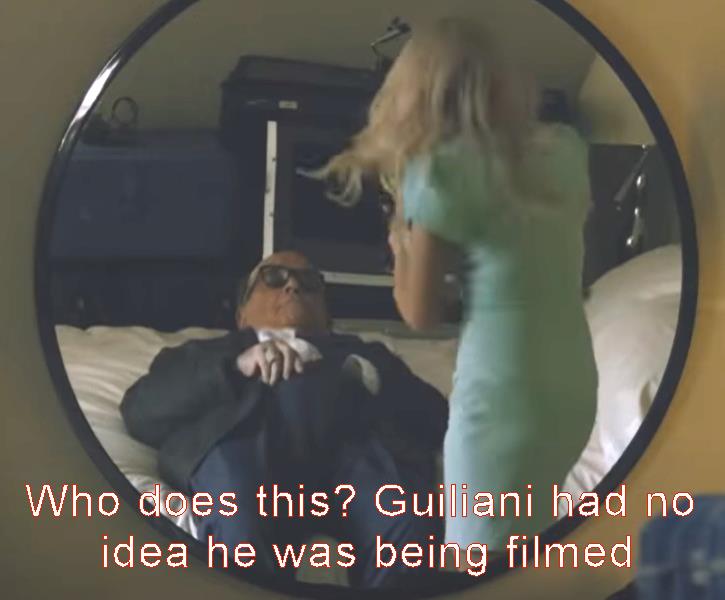
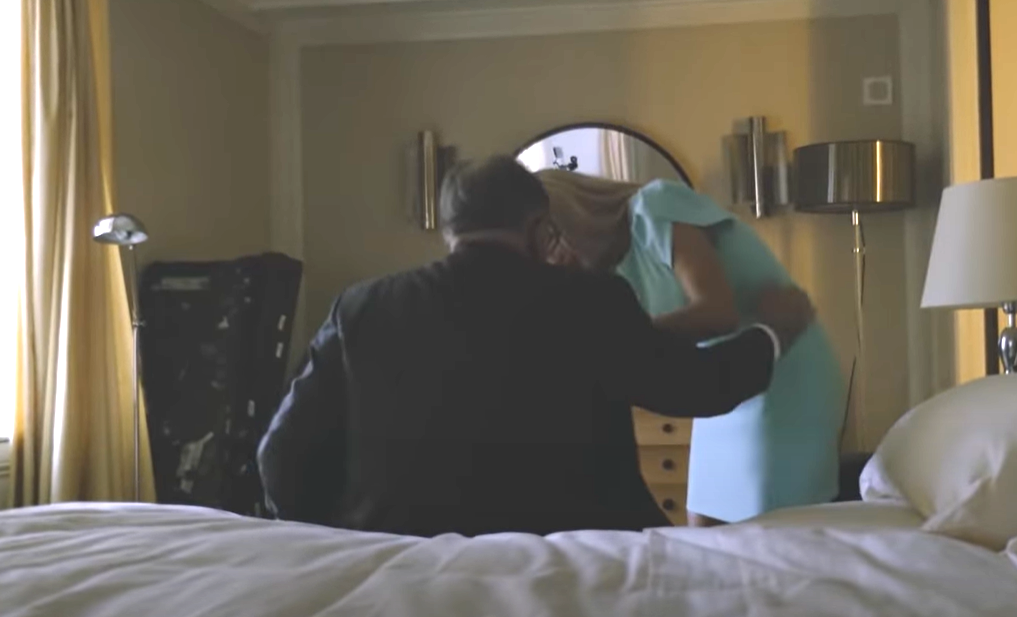
While Giuliani is facing a heap of legal trouble and possible indictment, he is fighting his own war for public opinion, trying to overcome bad press and convince everyone that he is not a criminal. A recent revving up of Giuliani’s public profile has been another in a long line of pranks, this one involving an incident between Giuliani and Maria Bakalova. In the latest season of a self-described "satirical comedy" series, Maria Bakalova conducts an interview with Giuliani while pretending to be a conservative journalist. Bakalova, who is quintessentially "too good to be true," claims that she is lifting interview questions straight from a favorite news program. And in a twist only a certain comedian could have come up with, the prank ended like this: Bakalova finishes the interview and gets Giuliani to step into a bedroom to "finish it." Giuliani lays down on the bed, seemingly to get his microphone removed. That’s when the comedian, in disguise, with Bakalova, enters the room as they have caught Giuliani in a compromising position.
Public relations, especially for an attorney with legal troubles, is a difficult game. For a political figure, even more so. For someone accused of trying to dirty a political opponent by digging up dirt composed of unproven speculation, there’s only so much one can do. What is interesting here is the idea that humorous actions in a TV series haunt a person to such a detrimental extent. Not all that long ago, some of the most beloved music, literature, and television shows of all time have been found to be deeply flawed and full of oppressive influences. The definition of humor has been weaponized for political leverage. In Brooklyn, someone defaced a banner featuring a famous vintage Dove of Peace with the Polish word for "fascist swine." Furthermore, basing one’s entire political outlook on the trajectory of a joke accusation made in reference to a comedy skit is absurd and points to a new low of political discourse in America.
11.1. Context of the Prank
Staff Meeting: February 29, 2020 - March 6, 2020 11.1. Context of the Prank
Sacha Baron Cohen’s prank on Rudy Giuliani is a comedy of very serious errors. It is a chapter that, apart from its grand humor, can also enlighten how scathingly far political satire is willing to reach. The setting is significant. It is revealing to think about how and why this hotel room was chosen. It was because CPAC was on, and so it became the very matrix of the prank. Sacha Baron Cohen spoofed Giuliani with the very man whom he has been spoofing on late-night TV. He lured Giuliani to a room by telling him he was interviewing him for a conservative news show. Giuliani may never have expected that the two foreign interlocutors could be from the satirical team of Borat. Yet the meeting that followed turned into a historic context separated from its comic character and its visible outcome.
Rudy Giuliani’s own legal predicaments brought into very towering attention a comic prank and satirical assault purely because Cohen was imitating his own assumption. Therefore, there was an ambiguity introduced by Cohen’s impersonation and the eviction of his impersonation during the prank. In terms of both moral judgment and social approval, Cohen’s politics paled when faced with publicized facts about Ed Russo’s actual backstory. Whether or not, as Judge Millard Lidecker has it, “it isn’t just a joke,” the pranking comedy that unfolded in public was no longer a mock combat of “real vs. fake” or “reality vs. fiction,” but of acceptable and unacceptable levels of hoaxing and masquerading, and it is not a fake authenticity. The “whys” and “wherefores” sunk in vanity in the “fact” of the matter. Even after Giuliani had shown his “color” or “natural” self, as it were, when faced by the intercourse that followed, and had made the crucial discovery concerning his political rivals’ ruse, the prank could not stand the source of its notoriety. The ethic of satire stood on the boundary of consent.
11.2. Reactions from Giuliani and the Public
In his initial responses to the coverage of the Oct. 23 release of Cohen's film, Giuliani first defended his actions as innocent. In a statement, he explained that "at 4:45, actually, after discussing COVID — and after arguing with the interminable Sasha Baron Cohen — Rudy Giuliani got a sudden urge to watch porn to which he quickly added, fiddling with his untucked shirt, coincidentally, all while he was on the phone," referring to himself in the third person. He later told radio that he was just tucking in his shirt after removing his recording equipment. Giuliani also appeared to defend himself by pointing out that he was fooled. "I thought about all the people he previously fooled and I felt good about myself because he didn't get me," Giuliani said. However, when asked if he had any indication that he was being set up, Giuliani would later say that he "smelled a rat." The comments came after Giuliani called the video that aired an "apparent complete fabrication."
Public reactions on social media to Cohen's prank, as well as to Giuliani's defense of his actions in the scene, varied greatly. Some voiced disgust and called for the 76-year-old former New York City mayor and Trump counsel to be fired or investigated for indecency, while others found the situation humorous and accused Giuliani's critics of seeking to deflect attention away from remarks about voter fraud. Still others called for a recusal from the Justice Department investigation into emails. Ultimately, the public reaction on social media to Cohen's prank amounted to both acceptance and rejection, reflecting the current environment of political satire. Politically affiliated comedic critique such as Cohen's comes with the impact and range of traditional political humor as well as the potential of marginalizing the artist as a nonpartisan satirist. Public figures continue to seek approval from audience members, yet the target of satire undoubtedly acknowledges the contradictory nature of consent and the rejective nature of contemporary political comedy. As a result, Giuliani responded to the built-in nature of comedic discourse by grappling with the public’s reception of his character in the sequel.
12. Comparative Analysis: Trump and Nixon
This isn’t the first time our government has defended an unpopular sitting president. As in the situation in 2019, Nixon was mired in scandal in July 1974, with multiple members of his administration testifying against him in Congress. In both cases, conservative outrage centered around the idea that the media and Democrats were up to no good when they opted to hold their leaders accountable for abusing the power of the government. And in both cases, the public was forced to defend the idea that an office-holding citizen can be the root of an effective and legitimate scandal; and they can do anything to keep their reputation.
Of course, there are a couple of differences. At the end of the day, Nixon was not an effective president. He often talks up his accomplishments, but mostly what he did with his second term was flaunt his power however he saw fit. Trump, meanwhile, still has many successes to boast about. Just because Nixon was one way doesn’t make Trump the same; the same goes for the reverse. But it’s still interesting to see that both presidents chose to deal with the media and their 'witch hunts' in roughly the same way.
13. The Role of Media in Shaping Public Perception
The concept of media and politics is at the core of the public’s perception of politicians and events. It comes as no surprise, then, that with the recent legal troubles of Rudy Giuliani, he now enters into a political and ideological minefield of public interest. Designed to shame and disgrace between different political platforms, types, and media outlets, whether they be from a left-leaning or right-leaning perspective, all have a story on Giuliani. This is of particular note because the characteristics of all the stories depend on the media source.
News channels, in a general sense, tend towards informational updates. They are, put simply, a place to catch up on current events. While they do skew towards politicized content, the overbearing sense of news clips is one of news release and content, strictly informational, and less focused on narrative bias. This is far from the narrative experienced with commentary on these news networks. Going to the right, we have instances of top names in conservative news slamming Giuliani. Some commentators detail that viewers “excused Rudy’s statements without reason,” and then sum up the underlying notion of trust within media: “bias is a wheel that spins both ways.”
Propaganda, sensationalism, and splaying news stories to fit any specific fabricated narrative, fake news, whatever you want to call it: it has hit the stands and public media domain unequivocally. Some can make meta-logical arguments, but the advertisements and narratives from mainstream media outlets re-echo a familiar undertone of media bias: that is, that the opposing media source is the one that is biased against the truth. Thus, we are coming to realize that we have a sort of proxy war in the Middle East, except this time it is not between the Middle Eastern nations of the world, but between the gatekeepers of certain land masses that sell stories and the news publishing companies who rely on these reporters to sell the news. All of this results from a bit of media fabrication.
14. Political Implications of Giuliani's Actions
Political Effects: Giuliani’s efforts at lying, ignoring, and sometimes validating his reputation for “dirty tricks” have helped to rally a larger portion of the public behind the Justice Department, the integrity of the elections, and the point of view of political opponents. Irrespective of the damage he’s done, one particular nerve is struck more sharply: Giuliani’s behavior forces sentient people to think deeply and negatively about not only Trump on the political question of raising doubts about the presidential election, but also the people who represent him, the worldview they have cultivated, and the approach they took to governance during their time in office. It is directly about Giuliani but also about, and beyond, regime change.
Campaign strategist headache: Giuliani’s situation is symbolic and suggestive of culture and ethics in the GOP, the former president’s inner circle, and the anti-confirmation bias world that those Americans who have sided against Trump’s critics on impeachment and responsibility for the riot harbor. The people outside Trump’s circle who have not been convinced that the former president or his community instigated a riot have succeeded in finding protective outlines around this part of the Capitol insurrection Venn diagram, while the former mayor and federal agent that Trump has most prominently deployed in his post-COVID rehabilitation campaign was making accusations without evidence or exaggerating the amount of the untraceable drug in an election-changing voting machine and filling his free time by reviewing as much of the electronic communications as he can find during his lunch hour. Then there’s the unanswered question about Giuliani’s fate. How will calls from these political allies, or similar revulsion in favor of some other higher guiding principle, appear in the elections? How much harder will the legal woes of Trump and potentially his kids be to hold against GOP candidates who are in no more trouble with the law than the rest of us? What’s non-customary about Giuliani ripping into people he’s worked on behalf of publicly for three decades is mostly that these people are going to have to do the political PR of disowning him – or straddling the fence of shared judgment – throughout his legal predicament.
15. The Future of Trump and Giuliani's Legacies
The future for Giuliani involves a parallel dimension, where Trump lost the 2016 presidential election and was thus spared the legal consequences of his leadership. He laughs, "Gosh, two more senators, two more states, the U.S. Capitol… and you really have to be able to control your own Department of Justice if you want to get away with that." It might be too soon to form robust predictions. But we can check our sources now, at the end of 2021. What will future generations remember Giuliani and Trump (both of whom are octogenarians) for? Will they dominate conversations about their era, or become incorporated into broader narratives about the kinds of political programs and political ideologies—an age of Trumpism or Giuliani-ism? Will recent improvements in Giuliani's public approval ratings "unlock" his name, so that the events comprising his legacy can no longer be taken for granted, and have to be made sense of by reference to an era, or a larger political aim, or narrative? Or will the opposite happen—"Giuliani," now synonymous with what his life's work has become—draw more people into positions of conviction that his era's convictions were complicit, unspeakable, per se? If Giuliani does not redeem himself, or soften sufficiently as time continues to pass, will that pay out over the careers of the generations of high school seniors reading about his political career for the first time, with what they read about 9/11 and mob bosses interesting to them more because it reflects political predation nearing its end, rather than political ambition day-to-day?
16. Conclusion
Our essay has sought to understand the Trump/Giuliani story at the intersection of their respective vindication campaigns, showing how involved the shady dealings of the former president's personal lawyer were with first Trump's pursuit of evidence that would exculpate him from any charge of collusion with the Russians, then with his own quest for proof that would finally exculpate him from the charge of unfairly losing the 2020 election. With the cover-up and the investigations well underway by late 2021, two years after the writing of this paper, we still do not know the full extent of these operations, nor can we fully evaluate their long-term impact. In conclusion, we wish to wrap up our presentation by restating our argument that politics and media, in and of themselves, will not fully uncover the truth about these very shady deals. At the same time, if overexposure has taught us anything, it has demonstrated the extent of the corruption and the dishonesty that directed both men's actions, their efforts at stabilization, or the narratives they have continued to build for the sake of the American polity. Only time will show Trump's, Giuliani's, and, to some extent, our reactions and conduct, beyond offering us a retrospective media imbalance that praised one, then castigated both, under the peculiar guise of historical constructivism. What will remain, the many lessons to be drawn will surely fail, as they usually do, in redirecting politicians from engaging in another search for legal exculpation prospectively or have us pay them greater attention retrospectively. Recent U.S. history is filled with intimations of accountability; of ethical conduct irreparably affecting or, in this instance, defining politics and public perception. Trump has expanded his lawsuits against U.S. media corporations. Whether he wins them or not, we shall end this piece with a constitutional question that no court has answered: if ethical behavior has indeed become extraneous, corrupting thought, let alone obstructing judgment, ours as well as politicians', should we all now be expecting the impossible?