

When Donald Trump announced his October 2025 “Middle East peace deal” involving Hamas and Israel, reactions were divided. Supporters hailed it as the long-awaited breakthrough that could end years of violence, while critics saw it as a headline-grabbing maneuver timed for maximum political impact. Observers have questioned whether the former president’s push for a ceasefire is a genuine bid for peace or a strategic attempt to regain the global spotlight and polish his legacy amid other controversies such as addressing dropping poll figures, trying to score a Nobel prize, or taking focus off Epstein. With Gaza in ruins and trust in diplomatic promises at an all-time low, the central question is whether this deal represents meaningful diplomacy—or political theater.
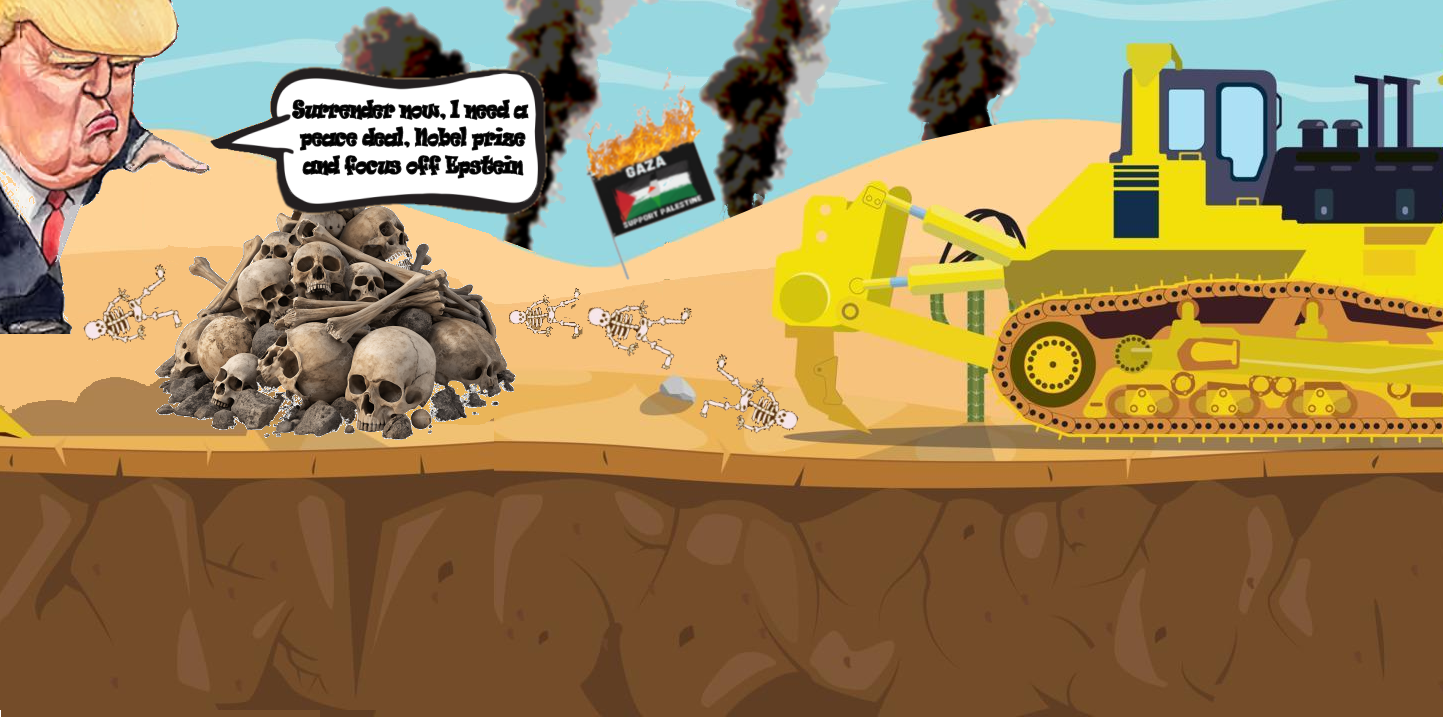
Context: how dire the situation is in Gaza
Before assessing whether Trump’s proposed “October 2025” peace/ceasefire deal with Hamas is meaningful or relevant, one must first reckon with the devastation in Gaza:
Gaza has been battered by a two-year war (starting October 2023) in which Israeli strikes and ground assaults have destroyed large swathes of infrastructure, housing, public services, and civilian areas. (The Guardian)
The death toll on the Palestinian side is enormous. According to the Gaza health ministry and various media and UN sources, more than 67,000 Palestinians have been killed. (Reuters)
Many of the victims are civilians — estimates suggest that women, children, and the elderly make up a majority of casualties. (The Guardian)
Entire neighborhoods, cities, or districts have been reduced to rubble; more than 90% of homes are damaged or destroyed; large numbers of people have been displaced (sometimes repeatedly). (Sky News)
Basic services (water, electricity, healthcare, sanitation) are severely degraded or nonfunctional in many areas, compounding the humanitarian crisis. (ReliefWeb)
In short: Gaza is not merely in crisis — it is on the brink of—or already in—the collapse of its civic, infrastructural, and social systems. The scale of destruction and loss is such that many observers describe the damage as near-total in some locations.
Given that backdrop, any “peace deal” or “ceasefire plan” must be evaluated not only on its political terms, but on whether it addresses the massive humanitarian and reconstruction challenges, and whether it recognizes that there may be no intact “Gaza” left to negotiate over in the familiar sense.
What is known about Trump’s October 2025 plan / first-phase deal
From media coverage:
On October 9, 2025, Israel and Hamas publicly agreed to a “first-phase” ceasefire / hostage exchange under terms associated with Trump’s plan. (Reuters)
Key elements include:
The release of all remaining Israeli hostages. (TIME)
Israel partially withdrawing troops to an “agreed-upon line.” (TIME)
Exchange of Palestinian prisoners and the release of hundreds of Palestinian detainees. (TIME)
Allowing a surge of humanitarian aid into Gaza. (Reuters)
Important caveats remain: the deal is only “phase one,” and many structural issues remain unresolved:
The exact timing, scale, and rules of the Israeli withdrawal are not fully fixed. (Al Jazeera)
Gaza’s future governance — whether Hamas continues to rule, whether a transitional authority is installed, or how security and disarmament would be enforced — is still in flux or subject to dispute. (Al Jazeera)
The disarmament of Hamas is a core demand of Israel (and the Trump plan) but is difficult to enforce, especially if Hamas retains control over underground networks or weapons caches. (TIME)
Many of the parameters for reconstruction, compensation, accountability, or war crimes investigations are either weak or absent in the announcements. (Al Jazeera)
So the deal, as currently formulated, is a fragile, partial step — more of a ceasefire / trampoline than a full “peace treaty.”
Is the deal “relevant” in this context?
Here is where the central question lies: given that Gaza has been so thoroughly destroyed and that millions of Palestinians (or many) have suffered mass death, displacement, and social collapse, can this peace deal meaningfully matter? Or does it risk being hollow or symbolic?
I will break down the assessment into several angles:
(1) Humanitarian importance
Even in a shattered territory, a ceasefire / hostage release / aid corridor can be extremely important:
Saving lives now. A pause in active combat means that civilians—already injured, malnourished, sick, trapped in rubble zones—might have at least some relief from bombardment, more access to medical aid, and a safer environment for evacuations.
Delivering relief and reconstruction. Allowing large-scale humanitarian access is essential if any rebuilding is to proceed. Without a ceasefire, aid organizations often cannot operate or reach many places. The first-phase deal acknowledges this need.
Psychological impact. For survivors, those still displaced, and families of hostages, the deal might offer a sliver of hope—or at least a stop to some of the worst suffering.
Thus, from a humanitarian lens, even a limited deal is not irrelevant. In fact, in such a dire environment, ceasefires are lifelines.
(2) Political and legitimacy dimension
But beyond immediate relief, there is the question: does the deal carry any political weight in the larger Israel–Palestine conflict, or will it be swallowed by the destruction?
Some factors undermine its potential:
The Gaza “baseline” is erased. If entire cities, neighborhoods, and population centers have been wiped out, there's very little “territory” left to negotiate over in any traditional sense. The bargaining chips have changed. The scale of loss may make assumptions in prior peace frameworks obsolete.
Power asymmetry. Israel is in a position of dominance, having conducted the offensive. Hamas (and Palestinian society) is weakened, fragmented, traumatized. The unequal balance raises concerns that any “deal” will favor the stronger side, reduce Palestinian leverage, and potentially codify the status quo of occupation or control by external forces.
Lack of enforceability. Given the destruction, preventing renewed hostilities, policing disarmament, and rebuilding governance institutions will be extremely difficult. A broken ceasefire or relapse into war is always a danger.
Long-term credibility. Many ceasefires or truce deals in past conflicts have broken down, especially when deeper issues (borders, sovereignty, justice, return of displaced persons, rights) are postponed or ignored. If the structural drivers of conflict remain untouched, the deal may be ephemeral.
Narrative vs reality. Since so many Palestinians are dead, homeless, displaced, and traumatized, some might perceive that no deal can rectify or redeem the loss. The moral and symbolic dimensions — justice, accountability — may dominate over any political “gain.”
So in political-structural terms, the deal is relevant only if it genuinely builds toward lasting change, not merely a pause. Its ultimate relevance depends on follow-through, enforcement, and justice.
(3) The question of “wiped out” and mass casualties
The user’s phrasing assumes a scenario: “Gaza was wiped out and millions of Palestinians, including children, were killed.” While the destruction and loss are indeed immense, several caveats:
The best public data suggests tens of thousands of Palestinian deaths (primarily civilians), not “millions.” (Reuters)
“Wiped out” should be understood as large-scale destruction, not full eradication. Significant portions of Gaza’s population, even if displaced, still remain; communities try to survive, recover, or return.
If hypothetically Gaza were entirely destroyed and depopulated, then any agreement would become more about claims, memory, and future returns than about a functioning territory. In that extreme, the deal’s relevance would depend almost entirely on symbolic, legal, and reparative dimensions.
So while the premise is somewhat hyperbolic, the underlying point is that the scale of destruction is so massive that it challenges what “peace” or “deal” can meaningfully do.
Conclusion: relevant — but only if ambitious and credible
Given the catastrophic damage and loss, Trump’s October 2025 deal cannot restore what has been lost. It cannot magically rebuild Gaza, resurrect lives, or fully redress decades (or more) of conflict. But “relevance” is not a binary. The deal can still matter — as a lifeline, a framework, and a stepping stone — if it is implemented robustly and with moral seriousness.
For the deal to transcend mere symbolism, it must:
Maintain a durable ceasefire, with mechanisms to monitor violations.
Ensure sustained humanitarian access and a realistic reconstruction plan with transparent funding and safeguards.
Address governance in Gaza: whether via transitional authorities, Palestinian institutions, or international oversight, while ensuring that Palestinians have a voice, rights, and security.
Achieve disarmament or demilitarization in a way that is verifiable, fair, and tied to security guarantees.
Incorporate justice and accountability, especially for civilians — war crimes, crimes against humanity, displacement — to avoid deep resentment and recurrence.
If it fails on these, it will likely be remembered as another short-lived pause that acknowledged tragedy but did little to remedy it.
In short: yes, the deal is relevant — especially for humanitarian relief and hostage return — but it is precarious. Its ultimate significance depends entirely on whether its promises are honored and whether it recognizes that peace must reckon with devastation, justice, and rebuilding, not just treaties.
If you like, I can write a version of this article as an op-ed or for a specific audience (e.g. international law, human rights, Palestinian perspective). Do you want me to reframe it?