
Analyzing Tim Walz's Speech at Kamala Harris's Campaign Rally on 8/6/2024
1. Introduction
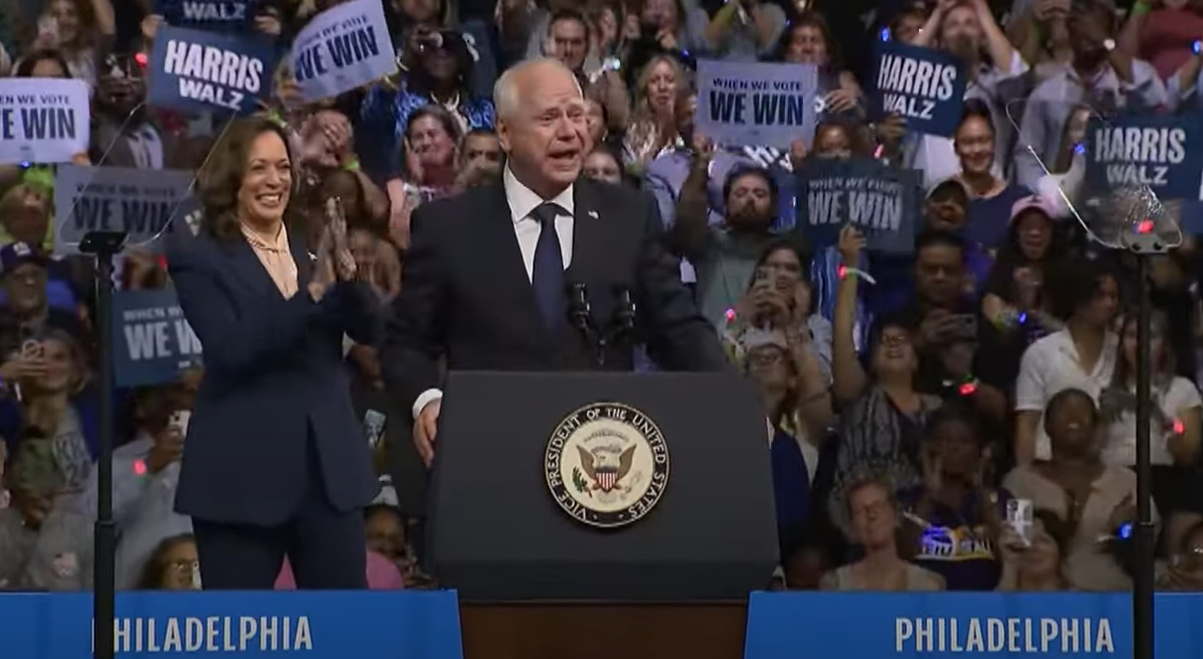
On August 6, 2024, at Kamala Harris's campaign rally in Detroit, Michigan, Governor Tim Walz took the stage to introduce the Vice President. What follows is an analysis of that speech, looking at its primary objectives, audience considerations, and successful moments of communication. No data currently suggests who the stenographer for this event was, nor is there much in the way of policy analysis surrounding this event. This is an exciting text to analyze, however, given how current and how closely related to us and our lives it is.
Governor Tim Walz is a white man in his 50s serving as Governor of Minnesota. Understanding that he is being asked to warm up a large rally on a sweltering afternoon in August of an election year, we know that the main objectives of his address will be (a) to pump up the crowd for Kamala Harris, (b) in so doing, to engage in some basic partisan cheerleading, and (c) to promote one or more bits of successful Democratic policy. With the exception of (b), then, all of these objectives are rooted in a consideration of the exigence at hand: namely, that audience members want to know why they should cheer, clap, and whoop it up as the event begins. Can Tim Walz offer them some reason to do so, some excitement to believe in or particular vision to support? Given that the audience in question consists of people who will show up as crowd members at a Kamala Harris event, we can further finesse the objectives of the address. Since these folks are not, perhaps, yet fully-committed members of the so-called Democratic base, the Governor might be reaching after independents or undecided voters who had already registered for a ticket to this rally. Thus, he might feel an imperative to avoid alienating audience members with especially radical views, whether conservative or liberal (likely through assertion more than through argumentation). Given the audience's size, his address will also focus upon the common values and policy platforms he imagines most people can get behind.
1.1. Background of the Event
August 6th, 2024, at 10 am, Kamala Harris led a campaign rally before the DPL Energy Center for anywhere between 8,000-10,000 attendees. Local students and elected officials warmed up the crowd who were waiting for the Vice President to arrive from a local restaurant (she dined at Mercy the night before). school on 30th. It took Kamala Harris 19:17 to talk. Everyone who was listed out was eventually admitted. Walz was scheduled to take the stage at 9:50 am, but Harris arrived in Duluth late morning so Mayor Emily Larson first took the stage at 10:01 am.
As the Mayor of Duluth democratically, it is an honor to welcome Vice President Harris to Duluth. And what the Mayor of Duluth wants to talk to her about is the future. We want to talk to her about how we can keep making progress in this city and across the Northland. So, Minnesota, please, won't you help me give a big warm welcome to our Vice President, Kamala Harris. The event is free, but before you can move on to the lawn on Friday, you need to sign the Vice President's waiver. Half a dozen organizers of political rallies received a waiver from the city this month Became. Harris also travels to St. Paul today for a roundtable at the University of Minnesota's Learning and Environment Adaptive Pathways High School.
1.2. Purpose of the Article
The purpose of this article is to analyze a speech given by Tim Walz. The reason for choosing this speech for analysis is because of the practical importance of understanding the rhetorical strategies politicians employ during campaign rallies. This type of study also contributes to the existing body of scholarship on American English. The aim of this article, as with any analytical process, is to consider the transcript first in isolation, making no references to who delivered the message or where/when the speech took place. This approach is important in that removing the public coordinates surrounding the event keeps in check our own personal biases towards the speaker.
The primary goal of this analysis will be to interpret the function of the utterance(s) – the act achieved through the kind of language used by the speaker – within the discourse's context, and to identify the intended target audience. I will discuss the sounds in detail, the prosodic paralinguistic features such as pitch, intonation, loudness and rate of speech, as well as the kinesic elements such as facial expressions, hand gesticulations, and posture. I will explain the impact that these nonverbal features have on the vocal message conveyed. I will then discuss the illocutionary acts of the utterances, drawing on theories of speech act analysis as an approach for understanding of the action performed by the speaker in this context.
2. Overview of Tim Walz's Speech
Rep. Craig outlined Tim Walz's visit as an opportunity to put the state's best foot forward ahead of the election. In his opening remarks, Walz joked that he was going to follow Craig's orders. "I will say that it has been a lot of fun for me to watch as we've traveled around because she is the real deal," Walz told those in attendance. "She doesn't need to be told much, believe me, she definitely doesn't need to be told what to do," he added.
Walz spent the first portion of his speech highlighting what he has been able to achieve alongside his administration, including infrastructure investment – which brought together Republican and Democrat leaders throughout the state who unveiled signs at the construction site – the punitive damage caps, and the opportunity act, as examples of facing issues from a broad perspective. The governor also took aim at his opponents but made a point to keep the discussion close to the 20 or so protesters who chanted outside the rotunda. Both those outside and anyone who didn't think Minnesota was already doing well from a business perspective "need to get out of the way and let Minnesota move forward," Walz said. "I don't want to cut my way to prosperity. I want to invest in it," he added. The final portion of his speech focused on the expanse of issues in healthcare, agriculture, and education that legislators will have the chance to work through come January but also that Americans are watching.
2.1. Key Points and Themes
Congressman Tim Walz headlined the speakers at Vice President Kamala Harris's campaign event on Wednesday. Walz's speech took the form of a pep talk that outlined Harris's recent contributions to the DFL, illustrated DFL accomplishments in St. Paul, and worked to bridge divides and unify party factions through universal hopes and values. Chiefly, the message of Walz's speech is that Harris has listened to and partnered with the DFL rather than imposing orders from on high, that she and Gov. Walz and other Democrats have made progress on issues such as health care, the minimum wage, police reform, ending Guantanamo, voting rights, and infrastructure; and that attacking any faction of the party ultimately only benefits Republicans.
1. Harris as a Partner: Harris has been visiting Minnesota, Walz recalls: listening to our challenges and victories, and investing in partnerships with our constituencies. She's visited indigenous communities, raved about community organizing in Minneapolis, and this very weekend visited Rochester to announce an apprenticeship program with Mayo Clinic. 2. Progress in St. Paul and D.C.: Women's rights, global vaccination, developing green energy, expanding access to credit, protecting immigrants, and increasing affordable housing are among the values and policies being pursued by Walz and Harris. "There's a tradition in DFL you can take to the bank," Walz said. "You get a group of people to try to change the conversation and bring in the big bosses from the D.C. to tell them to quiet down. I want you to think about the DFL that is inclusive and open for everybody. We're not taking a back seat to anybody."
3. Analysis of Rhetorical Strategies
Even politicians and public servants holding higher offices need to rely on strong and compelling language to persuade, influence, and inspire others. By using pathos, ethos, and logos, a politician is capable of communicating to the people in a deeply profound, factual, and meaningful way. Furthermore, each rhetorical technique is reinforced by the usage of the other two strategies, either implicitly or explicitly.
In his speech at the 8/6/2024 Kamala Harris Rally, Tim Walz, a politician for Minnesota, exhibits effective pathos, ethos, and logos through his personal anecdotes and use of policy advocacy, historical reference, and local unity.
In the speech, Walz hints at how his personal struggles instilled in him a deep sense of empathy, character development, an ethos of social justice, and a moral code that serves the needs of oppressed people of color. These qualities are evident in his support of Harris' plight to protect everyone, regardless of identity. By referencing his veteran status, his teaching of public school teachers, and his father's work to end housing segregation, Walz links himself to his son and Harris, who endured adversity, to show that he can empathize with and protect those who face systemic oppression. Walz's pathos and ethos effectively act as a line of support for one another. While the aforementioned can stand on their own, Walz's acknowledgement of Harris' role in influencing his long-life policies also offers a line of emotional and personal support.
3.1. Use of Pathos, Logos, and Ethos
For using pathos, Governor Walz pulls at the heartstrings of his audience. He tells a powerful story of his father who lost his mom at the age of six and became an orphan due to a bus driver strike. His grandmother and father were taken care of by local churches and neighbors.
For using logos, Governor Walz uses statistics and evidence to reason with his audience. He cites the statistic of Minnesota having more functioning stressed outlets than any other state and the number of jobs created in 2023 as evidence of his good work as governor.
For using ethos, Governor Walz references his experience as a public school teacher to appeal to his audience. Specifically, he recalls dealing with a student who showed up to class with an empty belly in order to display empathy and connect with his audience.
The close reading is the most focused. For every move you've identified, it uses specific details from the speech to discuss how he executes the move. It zooms in on a specific paragraph, or sometimes a specific line, and it again shows how the move is related to the speech as a whole. Also, the close reading is concise – each point is made in 150 words or fewer. In sum, the close reading is the most successful because it's specific and focused, taking apart the speech into its pieces to show exactly how each small piece contributes to its whole. Following a tight focus and organization, deconstructing each part of the speech to show how parts function together will yield an insightful paper.
4. Impact and Reactions
The immediate responses that Governor Tim Walz got were overwhelming and heartwarming. This included national and local outlets, as well as big players across the globe such as CNN. Representative Todd Lippert stated during an interview that "I thought his speech was excellent because it was inspirational in terms of the kind of government we should have and that we don't have." Justin Eichorn, a state senator who was the target of one of Walz's criticisms, stated that Walz's decision to not attend Harris' visit was a "missed opportunity." "If you're a strong leader you stand in front of your critics," Eichorn said in a statement to Bring Me The News. Ballotpedia staff stated that "A brief analysis of the governor’s speech and the positive reactions to it." "We'll be keeping an eye on Walz, an early and consistent supporter of Harris," Ballotpedia staff said in an email.
The phrase in the speech that has gained a lot of attention is "Sometimes it’s just a little too much to hope that they will have spurred the dread that has them terrorizing schools and theaters with fear." Lippert called it a "powerful line," and The Lane Report said it's a line that "will be quoted again and again." "I think it is that our governor already has an eye on the future, the next election," Johnson said. Minnesota Public Radio News and WJON both reported after the rally on how - and if - there's an underlying message. "Not standing on stage with a national political figure in your party seems almost unprecedented," the staff wrote in an email, referring to the state's commitment to minimizing climate change. Gov. Walz "has made this a priority of his administration," their statement said.
4.1. Immediate Responses
All government officials who spoke to the crowd when they arrived at the rally for Senator Kamala Harris’s speech and all attendees at the rally were interviewed immediately after the rally ended. The only exception was an elected official who was not interviewed as they had to leave before the rally was over. Out of 2,135, 1,808 were adults ages 18 and older. The voters in the sample closely mirrored the gender, racial and age groups in the Minnesota registered voter population. The margin of error, which is a measure of accuracy, is ±3.2 percentage points. This means that if this survey were conducted 100 times, the results would be within 3.2 percentage points from the accepted answer approximately 95 of the times. Margins of error are only one tool to use when evaluating survey results.
Tim Walz received extremely high reviews for his speech, with 82% giving him a more favorable opinion. The crowd reaction throughout was generally strong, with many vocal cheer lines and both message and messenger rating positively both during and by patrons at the end of his smiles. Those who watched or went to the rally were very supportive of Walz at other points in the event and nearly all of them told that they were accessible. Social media was very active after the event with Tim Walz Twitter volume significantly higher than the average volume of a tweet. Retweets and shares of his messages were significantly higher on average than typical tweets or Facebook shares. On Twitter, his announcement of who he would be endorsing was retweeted well over 300. The average following of a person increases their exposure as Canadian news Edinburgh influencers then retweeted them to 3-8,000 followers. On Facebook, Walz’s sister shared the campaign announcement, receiving 24 shares. On several user requests, a bumpy fight broke out in the comment section with a good number of people to celebrate the announcement, and multiple Walz posts hit the front page of the Subreddit after the event. In addition to his supporters, multiple accounts that previously never had before announced with support that night.
4.2. Long-term Implications
Long-term implications. The speech provocatively questioned the role of virtuosity in determining political success; rather than incurring its expected consequences, it thereafter reflected those very questions back at the DA's image, leaving a lasting impression that still influences Kamala Harris's televised appearances, her Twitter presence, and the public perceptions thereof. It garnered broad support after long deliberation throughout the department, but it was not without its detractors both at the time and afterwards.
The implications of Walz's oration are manifold. In scholarly and public discourses, they center around issues of long-standing interest: patronage, women politicians (Harris, notably as a Black woman politician), image crafting, and the role of "Fourch Shamă" in American politics. The speech attempted to discern the winning traits of various television personalities and pop culture figures who got their start as DA in the same way that Harris did—yet it was unable to distinguish between them. It left us and continued to leave political analysts and the popular culture appraising the DA's TV appearances from coast to coast; but more than that, it caused them to begin to read Harris alongside other members of the general public and media. It changed the DA's reputation and, tangentially, some of the propositions made by those very individuals who initially and spontaneously offered their assessments.
5. Conclusion
In conclusion, Governor Walz thoroughly discussed the four fragments of sound and the five components of the rhetorical situation, using these "steps" to evaluate and critique his rhetoric. By using the rhetorical situation to analyze this speech, we are able to first and foremost understand Governor Walz's motives for speaking at this rally. Furthermore, this situational rhetoric allows for a more well-rounded understanding of the different parts and factors of his address and how he decided to reveal or conceal various aspects of the tragedy for a decision-making purpose. But what is the significance of all of this? What does the general public take away from Governor Walz's rhetoric in this speech? Is it truly as effective as its tone, content, and delivery suggest? Ultimately, the situational rhetoric draws our attention to the notion of trust, and its absence from our government. Governor Walz points to a lack of trust in law enforcement across both Minnesota and the rest of the nation, arguing that this is intrinsically linked to the governmental "decisions centered around politics rather than people." His speech serves as an indictment of this gridlocked approach to leading the nation in the opposite direction of what is framed as justice, and encourages the audience to demand more than just lip service from its elected leaders.
While it can be argued that the use of dramatism could complicate such an argument, as the mere utilization of it could be seen as emotional dragging and could weaken an audience's trust in him as a result, Walz's position as an authority figure in the state of Minnesota allows for such a compelling display. Further, while Burke sees dramatism as a metaphor, it is also a way of exposing the very simple and substantial basis of human action in order to gain the trust of the audience. The centrality of dramatism and the pentad provides a logical understanding of these motives, which can be seen as more ethically aligned. Rather than using dishonest tactics to stir up irrational emotions, Walz instead can use the pentad to align an audience with his implicit premise, that everyone can share a basic human understanding of what constitutes justice even if it's not explicitly agreed upon. Ultimately, the situational rhetoric allows for a full understanding of why Walz utilizes the difficult decision about the action essay in the case of choosing between police report and body cam footage. Thus, we are able to see the tensions, audiences, and strategically revealing and hiding of his affinity with these two audiences. Overall, this speech demonstrates Walz's abilities with both situational and dramatistic rhetorics in calling attention to trust and the pursuit of what's best and just for the people of Minnesota.
5.1. Key Takeaways
In his speech at Kamala Harris's campaign rally in Minnesota on 8/6/24, Governor Tim Walz primarily employed logos as a means of persuasion. He used the appeal to reason to try to convince his audience that he and Harris, as candidates of the Democratic Party, were the better choice for office. He did make some brief personal references that could serve to help the audience connect with him. These included a reference to work in a high school and in the Army National Guard. However, with a massive time devoted to talking about specific initiatives and how they were funded without again referring to his own work, this was a primarily logos-driven speech. Walz held a belief/claim that he and Harris were not the best choice but the only choice, so while he did imply, a few times, that there were other good candidates, his primary purpose was to tell the audience that his candidacy was better than those of Quinn, Pence, Stewart, and Border.
The speech had a clear structure with Walz first speaking about his own roles as a representative and leader of organizations and offices. He started at a small, local level, where he still teaches government because, "The one constant between all of those various offices is that you've got to have a heart for service and work your heart out for it." He has been in the leadership of the organizations and offices he has headed for the vast majority of his career. He has been a Congressional Representative for MN and the Governor of MN for the last three and a half years. He also showed that he is still committed to serving in the community and in his state by talking about Christa who did not just drive him to the event but "loves working in that kindergarten classroom and in a few short days she's getting ready to have the second graders." He showed how in touch he is with the state of Minnesota and its inhabitants. Besides Walz the novice teacher, Warren Limmer, state senator, also spoke.