
Why Haven't There Been Any Truly Great Rock and Pop Singers Since the 1990s?
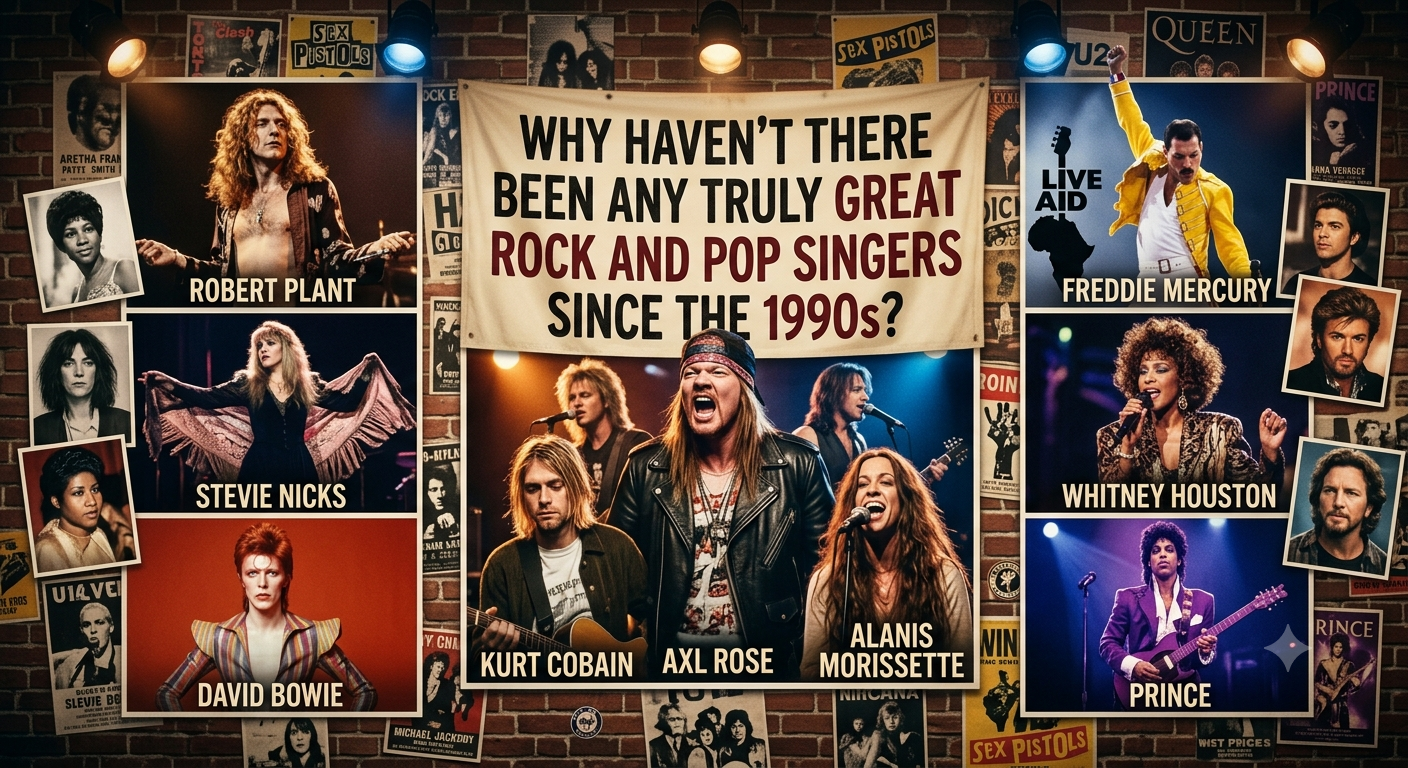
Music is inherently subjective. Not only do opinions vary across genres, but they also vary across generations. I'm taking an opinionated stance here, but to my ears, singers before roughly the year 2000 sound fundamentally different from those who came afterward—with a few notable exceptions.
Going back to the 1950s, Buddy Holly, whose style was heavily influenced by blues and gospel, was one of the first major rock singers to regularly step outside what vocal coaches considered proper technique. He would intentionally push beyond his comfortable vocal range—something that was considered a definitive "no-no" at the time and, in many circles, still is today.
Even artists like Elvis Presley and The Beatles, who began with relatively polished vocal technique, gradually pushed beyond what was considered "safe." Blues and gospel singers, meanwhile, often seemed unconcerned with those rules from the beginning. Long before rock music existed, many gospel and blues vocalists embraced raw emotion over technical perfection.
By the late 1960s, throughout the 1970s, and especially during the 1980s and the grunge era, many rock singers seemed to be intentionally abusing their voices—or at least that's how it appeared through the lens of traditional vocal coaching. They found ways to stretch the physical limits of the human voice with screams, soaring belts, gritty rasps, and piercing high notes while still maintaining impressive control, vibrato, agility, and phrasing. They could transition effortlessly between notes, execute rapid vocal runs, change vowel shapes without losing power, and sustain incredible resonance. It almost seemed superhuman.
Then there was that elusive vocal rasp—a quality that many people mistakenly believe comes from smoking or excessive screaming. In reality, that kind of controlled distortion is a highly specialized technique that is extremely difficult to master without damaging the voice.
Some of the greatest examples of this vocal prowess emerged during this period. Robert Plant and Ian Gillan helped redefine what rock vocals could be. Later came Steve Perry's remarkable control and range, Don Henley's understated but unmistakably powerful voice, and the explosion of 1980s hard rock and heavy metal frontmen like David Coverdale, David Lee Roth, Brian Johnson, Bruce Dickinson, and Rob Halford.
Across other genres, the level of vocal individuality was equally astonishing. Michael Jackson possessed what may be one of the most instantly recognizable and nearly impossible-to-duplicate voices in popular music. Prince was equally distinctive. Then came Axl Rose, whose enormous range defied expectations, followed by the grunge singers, who often replaced polished technique with raw emotional intensity while still displaying remarkable vocal endurance. Even the disco and R&B singers of the 1970s showcased extraordinary vocal ability.
Then something seemed to change around the early 2000s.
Popular music began favoring younger-sounding voices with flatter tones, fewer vocal acrobatics, less dynamic range, and a conversational style that often bordered on nasal. Rather than celebrating singers who sounded larger than life, the industry increasingly embraced artists who sounded more relatable and understated. Since then, I struggle to name many rock or pop vocalists—aside from a handful of exceptions, such as Bruno Mars—who consistently leave me in awe of their vocal ability.
So what happened?
Several factors may have contributed.
First, musical tastes changed. The larger-than-life arena rock vocalist gradually gave way to indie rock, alternative pop, hip-hop, and electronic music. In many of these styles, authenticity and emotional vulnerability became more important than vocal virtuosity. A voice with imperfections could feel more genuine than one that sounded technically flawless.
Second, recording technology evolved. Modern pitch correction and digital editing made it less necessary for singers to deliver extraordinary live vocal performances. While great singers still benefited from these tools, average singers could now sound exceptional in the studio. As a result, vocal excellence became less of a competitive advantage than it had been decades earlier.
Third, songwriting itself changed. Earlier generations often wrote melodies that demanded wide vocal ranges, sustained high notes, and dramatic dynamics. Contemporary pop frequently favors rhythmic delivery, intimate vocals, and melodies that sit within a relatively narrow range. If the songs don't require extraordinary singing, fewer singers will develop those skills.
Finally, the music industry changed. During the classic rock era, labels invested years developing artists, and live performance was often the ultimate proving ground. Today, viral success, streaming algorithms, and social media visibility can elevate an artist long before they have spent years refining their voice through relentless touring.
None of this means today's singers lack talent. There are still phenomenal vocalists working in rock, pop, country, R&B, metal, and other genres. But mainstream popular music no longer seems to reward the kind of vocal spectacle that once produced singers like Robert Plant, Freddie Mercury, Steve Perry, Whitney Houston, Michael Jackson, or Bruce Dickinson.
Perhaps the great rock and pop singers haven't disappeared at all. Perhaps they've simply become less fashionable. The industry no longer asks singers to be vocal athletes—it asks them to create songs that connect instantly. Whether that represents progress or decline depends entirely on what you value most in music.